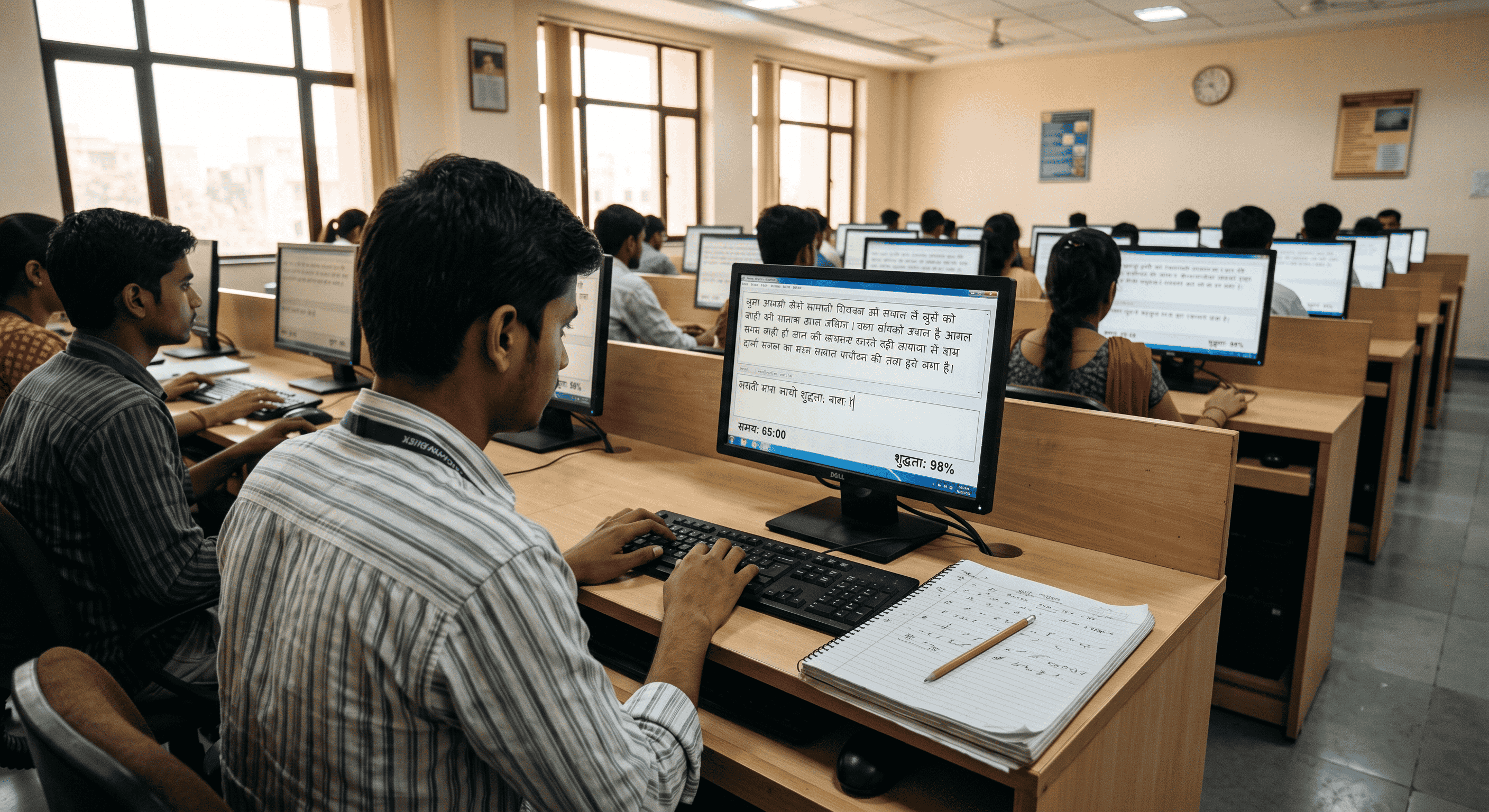
UPSSSC Stenographer Skill Test 2026: Hindi Typing & Shorthand Preparation Guide
If you are preparing for the UPSSSC Stenographer Skill Test 2026, you already know that clearing the written exam is only half the battle. The real challenge for many candidates is the skill test, which strictly evaluates your Hindi shorthand capabilities and Hindi typing speed under pressure.
For government exam preparation, consistency is everything. Whether you are coming from an SSC Stenographer background or focusing purely on state-level exams, adapting to the specific requirements of the UP Subordinate Services Selection Commission (UPSSSC) takes a solid strategy.
In this guide, we will break down exactly what to expect, how to choose between Kruti Dev and Mangal fonts, and provide a daily study plan to help you pass your typing test and shorthand dictation with flying colors.
UPSSSC Stenographer Skill Test 2026: What Candidates Should Know
The UPSSSC stenographer exam is known for its precise evaluation. Unlike some general typing exams, this test demands absolute accuracy. The commission evaluates how quickly you can take dictation in Hindi and how accurately you can transcribe that dictation onto a computer.
Why does early preparation matter? Many candidates wait until the written results are out to start typing. This is a massive mistake. Building muscle memory for shorthand outlines and keyboard layouts takes months, not weeks. Starting now gives you the edge to refine your typing speed and typing accuracy without last-minute panic.
UPSSSC Stenographer Skill Test Pattern
Understanding the exact requirements of the test is your first step. Below is the standard pattern expected for the 2026 cycle:
| Skill Tested | Required Speed | Language | Time Allotted (Approx) |
|---|---|---|---|
| Shorthand Dictation | 80 Words Per Minute (WPM) | Hindi | 5 Minutes Dictation |
| Transcription / Typing | 25 Words Per Minute (WPM) | Hindi | Varies (Usually based on dictation length) |
Hindi Shorthand: How to Prepare
Taking down dictation at 80 WPM in Hindi requires strong fundamentals. If you are familiar with Pitman shorthand or any recognized Hindi shorthand system (like Rishi or Manak Pranali), your focus now should be on continuous practice.
- Focus on Phrasing: Combine small words to save time. Joining words naturally speeds up your writing.
- Read What You Write: Taking down the dictation is useless if you cannot read your own strokes. Dedicate time to reading your notes immediately after writing them.
- Practice with Unseen Passages: Do not just practice the same essays. Use audio dictations from parliamentary debates, news editorials, and official letters.
Hindi Typing: Kruti Dev vs Mangal
One of the most common questions candidates ask is whether they should practice Kruti Dev typing or Mangal typing. Historically, UPSSSC has allowed both, but you must be prepared for the software interface.
- Kruti Dev (Non-Unicode): This is a traditional font. It requires memorizing several Alt codes for special characters (like half letters). It is widely used in older state departments.
- Mangal (Unicode - Inscript/Remington): Mangal is a Unicode font standard. The Remington layout is highly similar to Kruti Dev, making it easy for Kruti Dev typists to switch, while the Inscript layout is totally different.
Recommendation: If you are starting fresh, Mangal (Inscript) is highly recommended for modern government exams. However, if you already have a 30+ WPM speed in Kruti Dev, stick with it. Just ensure you master the Alt codes.
How Much Typing Speed Should You Target?
The official requirement is a 25 WPM Hindi Typing Test. However, exam day nerves, stiff keyboards, and software interface anxiety can easily drop your speed by 5 to 8 WPM.
To safely clear the 25 WPM threshold, your practice speed at home should consistently hit 35 to 40 WPM. At this speed, even if you make a few mistakes or struggle with a specific word, you will still easily cross the minimum passing line.
Common Hindi Typing Mistakes
- Ignoring Half Letters: Words requiring half letters often slow candidates down. Practice complex words daily.
- Overusing the Backspace: While backspace is usually allowed, relying on it ruins your rhythm and heavily impacts your typing speed.
- Poor Sitting Posture: Slouching reduces blood flow to your fingers, causing fatigue during long transcription sessions.
- Ignoring Formatting Rules: Strict tests like the Allahabad High Court formatting exams penalize extra spaces. Treat UPSSSC with the same caution. Never use double spaces after a full stop.
How to Practice Shorthand + Typing Together
Many candidates practice shorthand in the morning and typing in the evening as separate subjects. For the skill test, you must combine them.
Take a shorthand dictation, and immediately sit down at your computer to transcribe it. This trains your brain to read your shorthand strokes while simultaneously locating the Hindi keys on the keyboard. Online typing practice platforms are incredibly helpful for this phase of preparation.
Daily 2-Hour Preparation Plan
If you can dedicate just two hours a day to focused practice, you will see massive improvements. Here is a sample daily routine:
- 0-30 Minutes: Shorthand dictation practice (Take 3-4 short dictations at varying speeds).
- 30-60 Minutes: Reading shorthand notes and identifying outlines you struggled with.
- 60-90 Minutes: Transcription (Typing out your shorthand notes on the computer).
- 90-120 Minutes: Focused Hindi Typing Test practice on a software platform to measure raw speed and error rates.
How to Improve Accuracy Before the Skill Test
Speed without accuracy will result in failure. When you type, your eyes should be glued to the screen or your steno pad, not the keyboard. If you notice your accuracy dropping below 95%, slow down. It is better to type at 28 WPM with 98% accuracy than 40 WPM with 85% accuracy.
Final-Day Skill Test Checklist
When the big day arrives, keep these things in mind:
- Carry all mandatory documents (Admit Card, Original ID, Photographs).
- During the keyboard check phase, press every single key. Check the spacebar, backspace, and shift keys thoroughly. If the keyboard is faulty, request an immediate replacement.
- Adjust your chair to ensure your wrists are comfortable.
- Do not panic if you miss a word during the shorthand dictation. Leave a small space and catch up with the next sentence.
Free Hindi Typing & Shorthand Practice Resources
To succeed, you need the right tools. At Free Shorthand Typing, we provide a comprehensive online stenography learning and practice platform.
Whether you need a Pitman exercise, an English typing test for other exams, or specific practice for your UPSSSC Hindi typing test, our platform has you covered. We offer realistic test interfaces, manual error calculation guides, and extensive dictation libraries designed specifically for government job aspirants.
Frequently Asked Questions (FAQs)
1. What is the typing speed required for the UPSSSC Stenographer test?
You need a minimum typing speed of 25 Words Per Minute (WPM) in Hindi.
2. What is the shorthand dictation speed for UPSSSC?
The dictation is given at 80 Words Per Minute (WPM) in Hindi.
3. Which font is used in the UPSSSC Hindi typing test?
Generally, candidates are given the option to choose between Kruti Dev and Mangal (Inscript/Remington) layouts. Always verify with the official notification for the specific year.
4. Is the backspace key allowed during the UPSSSC skill test?
Yes, backspace is typically allowed, but excessive use will naturally lower your final WPM count.
5. Can I use a custom keyboard for the exam?
No, you must use the standard membrane keyboard provided at the examination center. Practice on standard, basic keyboards at home.
6. How are typing mistakes calculated?
Mistakes are generally categorized into full mistakes (missing words, spelling errors) and half mistakes (spacing issues, punctuation). Accuracy is highly prioritized.
7. I am an SSC Stenographer aspirant; can I apply for this?
Absolutely! The skills are highly transferable. If you already practice for the SSC Stenographer Hindi skill test, you are well-prepared for UPSSSC.
8. How long does it take to learn Hindi shorthand?
If you are starting from scratch, it typically takes 6 to 8 months of dedicated daily practice to reach an 80 WPM dictation speed.
Final Conclusion
Clearing the UPSSSC Stenographer Skill Test 2026 is entirely achievable with a disciplined approach. Do not treat shorthand and typing as separate tasks; they are two halves of the same job. Focus heavily on reading your own outlines, mastering either Kruti Dev or Mangal, and pushing your practice speed 10 WPM higher than the required exam speed.
Remember, the exam hall environment is stressful, but muscle memory never lies. If you put in the daily hours, your hands will do the work automatically when the timer starts.
Ready to Boost Your Speed?
Don't wait until the last minute. Start your focused preparation today with Free Shorthand Typing. Explore our extensive library of dictations, test your speed in our real-time typing environment, and track your progress to guarantee your success in 2026!