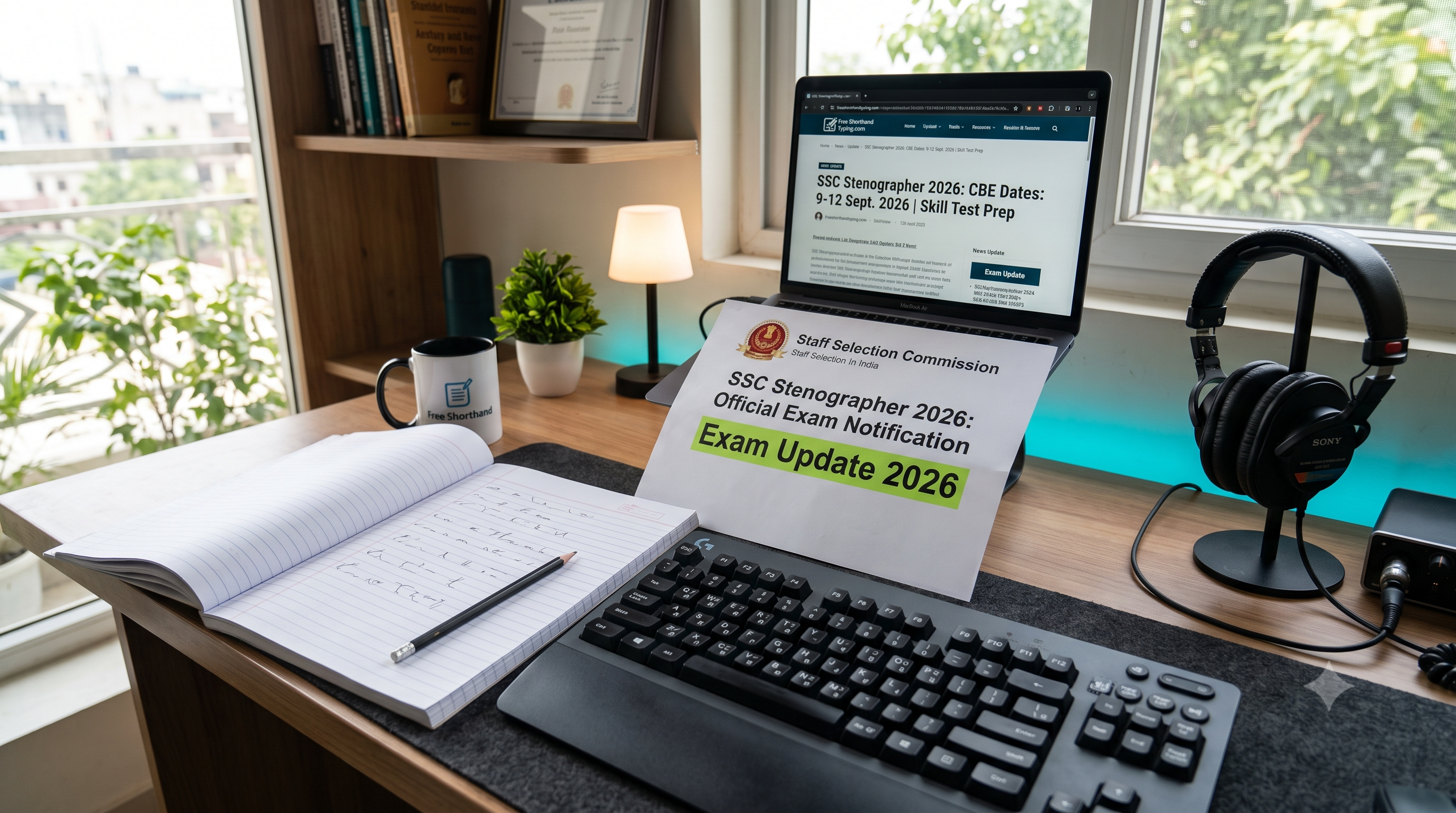
The recruitment season for government stenography aspirants is officially in full swing. With the Staff Selection Commission locking in dates for the SSC Stenographer (Grade 'C' & 'D') 2026 Computer-Based Examination and major judicial recruitment drives—including the Allahabad High Court Private Secretary and Stenographer posts—gaining momentum, candidates must align their written test revision with daily shorthand dictation and transcription practice.
Qualifying the written examination is only the first hurdle. The actual selection in prestigious central departments and judicial benches comes down to your performance in the skill test. In this updated exam bulletin and prep guide, we cover the latest official timelines, skill test requirements, and actionable strategies using the practice tools on Free Shorthand Typing (freeshorthandtyping.com).
Latest Exam News & Official Updates (2026 Session)
Staying informed about the official calendar helps you pace your preparation effectively across both written papers and skill test drills.
- SSC Stenographer 2026 CBE Schedule: The Computer-Based Examination for Grade 'C' and 'D' is scheduled to be conducted between September 9 and September 12, 2026. Candidates who clear the written cutoff will be shortlisted for the subsequent shorthand skill test.
- Allahabad High Court & District Courts Skill Updates: Recruitment notifications for Private Secretary Grade-I and Stenographer Grade-III require strict adherence to standard high court transcript layouts, requiring candidates to handle both general administrative and legal terminology.
- Standardized Keyboard Layouts: For all upcoming Hindi stenography and typing tests, testing agencies continue to mandate Mangal typing (specifically Remington Gail and Inscript layouts), while specific state departments still preserve options for Kruti Dev typing.
Exam Matrix: SSC vs. High Court Skill Test Standards
Different recruiting bodies set distinct evaluation parameters. Here is a clear breakdown of the speed, time, and formatting benchmarks you must meet:
| Recruitment Exam | Post / Grade | Dictation Speed | Transcription Time | Permissible Error Margin |
|---|---|---|---|---|
| SSC Stenographer | Grade 'D' (English) | 80 WPM (10 mins) | 50 Minutes | 5% - 7% (UR) / 7% - 10% (Reserved) |
| SSC Stenographer | Grade 'D' (Hindi) | 80 WPM (10 mins) | 65 Minutes | 5% - 7% (UR) / 7% - 10% (Reserved) |
| SSC Stenographer | Grade 'C' (English) | 100 WPM (10 mins) | 40 Minutes | 5% (UR) / 7% (Reserved) |
| SSC Stenographer | Grade 'C' (Hindi) | 100 WPM (10 mins) | 55 Minutes | 5% (UR) / 7% (Reserved) |
| High Court / Legal Steno | Steno / PS Grade | 80 - 100 WPM | Standard Time + AHC Formatting | Strict Legal Evaluation Criteria |
Why You Must Not Delay Your Skill Test Practice
One of the most common mistakes made by government exam preparation candidates is waiting for the written CBE results before picking up the steno pencil or practicing on the keyboard. Building auditory muscle memory and shorthand speed takes months of consistent effort.
Transitioning from 60 WPM to a consistent 80 WPM or 100 WPM requires daily audio dictations, accurate outline drafting, and full-length computerized transcriptions. Delaying your skill test practice until the written result announcement leaves you with insufficient time to bridge speed gaps or master difficult legal and parliamentary vocabulary.
Step-by-Step Skill Test Preparation Plan
Follow this daily 5-step blueprint to ensure your shorthand and typing skills peak right in time for the test:
- Daily Pitman Exercise Drill (15-20 Minutes):
Reinforce your foundational grammar rules, special contractions, intersections, and phraseograms. Sharp, precise strokes prevent transcription hesitation.
- Live Dictation Practice at Graded Speeds (30 Minutes):
Practice with audio tracks at 80 WPM and 100 WPM. Include both editorial speeches (for SSC) and court judgments (for High Court exams) to build versatility.
- Mental Reading & Annotation (10 Minutes):
Immediately after taking the dictation, read through your handwritten shorthand notes. Mark any blurred strokes with a pencil before touching the keyboard.
- Full-Length Timed Transcription (45-50 Minutes):
Use an online typing practice tool to transcribe the entire passage against the clock. Focus on consistent rhythm rather than erratic speed bursts.
- Accuracy Verification & Error Log:
Review the automated error report to identify omitted words, punctuation misses, or spelling errors. Copy every problematic outline 25 times into your steno notebook.
Pro Tip: When transcribing court passages, pay close attention to Allahabad High Court formatting. Align case numbers, margins, quotation indents, and paragraph breaks precisely as mandated in judicial exam notices.
Key Differences: Editorial vs. Legal Dictation Passages
Understanding passage context is vital for eliminating misheard words during transcription:
1. General & Editorial Dictations (SSC Focus)
These passages draw from parliamentary debates, economic development surveys, and editorial columns. Key recurring terms include "Madam Speaker," "Honourable Minister," "socio-economic development," and "public welfare schemes."
2. Legal Dictations (High Court & Judicial Focus)
Legal passages contain formal judicial terms, statutory citations, and Latin phrases. Common terms include "appellant," "respondent," "writ petition," "learned counsel," and "interim injunction." Practicing specialized legal outlines is essential for court stenographer selections.
Common Mistakes to Avoid in Skill Tests
- Excessive Backspacing: Constantly editing typed words destroys your typing rhythm and wastes valuable transcription minutes.
- Inconsistent Stroke Density: Failing to differentiate light and heavy strokes in Pitman shorthand turns simple words into major transcription mistakes.
- Ignoring Font Differences: Practicing solely on legacy fonts like Kruti Dev when the exam interface requires Mangal Unicode Remington Gail.
- Skipping Audio Diversity: Training only on clear, studio-recorded audio. Official test halls often have natural room echoes, so practicing with varied audio tracks helps avoid panic on exam day.
Accuracy Check: In both SSC and High Court skill evaluations, a missing punctuation mark or singular/plural slip counts as a half mistake, while an omitted word counts as a full mistake. Prioritize accuracy over raw typing speed.
Frequently Asked Questions (FAQs)
1. When is the SSC Stenographer 2026 exam scheduled?
The SSC Stenographer 2026 Computer-Based Examination (CBE) for Grade 'C' and 'D' is scheduled to take place from September 9 to September 12, 2026.
2. What is the required shorthand speed for SSC Grade C and D?
The dictation speed is 80 WPM for 10 minutes (800 words total) for Grade 'D' and 100 WPM for 10 minutes (1000 words total) for Grade 'C'.
3. Which keyboard layout is used for the Hindi typing test in SSC exams?
SSC provides Hindi typing candidates with Mangal font on both the Inscript and Remington Gail layouts. Candidates choose their preferred layout during application or at the exam center.
4. How much typing speed is required alongside shorthand?
While shorthand is dictated at 80 or 100 WPM, you need a comfortable raw typing speed of 35-40 WPM in English or 30-35 WPM in Hindi to complete and proofread your transcription within the allotted time.
5. What is the permissible error percentage in SSC Stenographer skill tests?
Generally, the permissible error limit is up to 5% to 7% for unreserved candidates and up to 7% to 10% for reserved category candidates, depending on the specific post (Grade C or Grade D) and official cutoff notices.
6. What are the specific requirements for Allahabad High Court formatting?
Court transcripts require formal legal layout adherence, including exact line spacing, indented block quotes for judicial citations, capitalized case titles, and structured paragraph numbering.
7. How can I boost my shorthand capture speed from 70 to 80 WPM?
Take dictations using the speed-push method: practice audio passages at 90 WPM (10 WPM higher than your target), then return to 80 WPM dictations. The target speed will feel noticeably easier to record accurately.
8. Where can I practice realistic shorthand dictation and typing tests online?
You can access complete audio dictations, Pitman exercises, and exam-simulated English and Hindi typing tests directly on Free Shorthand Typing.
Conclusion: Start Your Exam-Ready Practice Today
With major recruitment tests scheduled across the year, maintaining a disciplined, exam-oriented practice routine is the key to securing your name in the final merit list. Focus on clean shorthand strokes, master your keyboard layout, and test yourself under strict timed conditions every day.
Boost your shorthand and typing accuracy with free tools, graded audio tracks, and exam-pattern test interfaces. Visit Free Shorthand Typing today to practice shorthand dictations, take live typing tests, and accelerate your government exam preparation.
Popular Tags:
- SSC Stenographer 2026
- Exam News
- Skill Test Date
- Allahabad High Court Formatting
- Pitman Shorthand
- Shorthand Dictation
- Typing Test
- Kruti Dev Typing
- Mangal Typing
- Typing Accuracy
- English Typing Test
- Hindi Typing Test
- Online Typing Practice
- Government Exam Preparation
- Steno Grade C
- Steno Grade D
- High Court APS
- Speed Building
- Transcription Practice