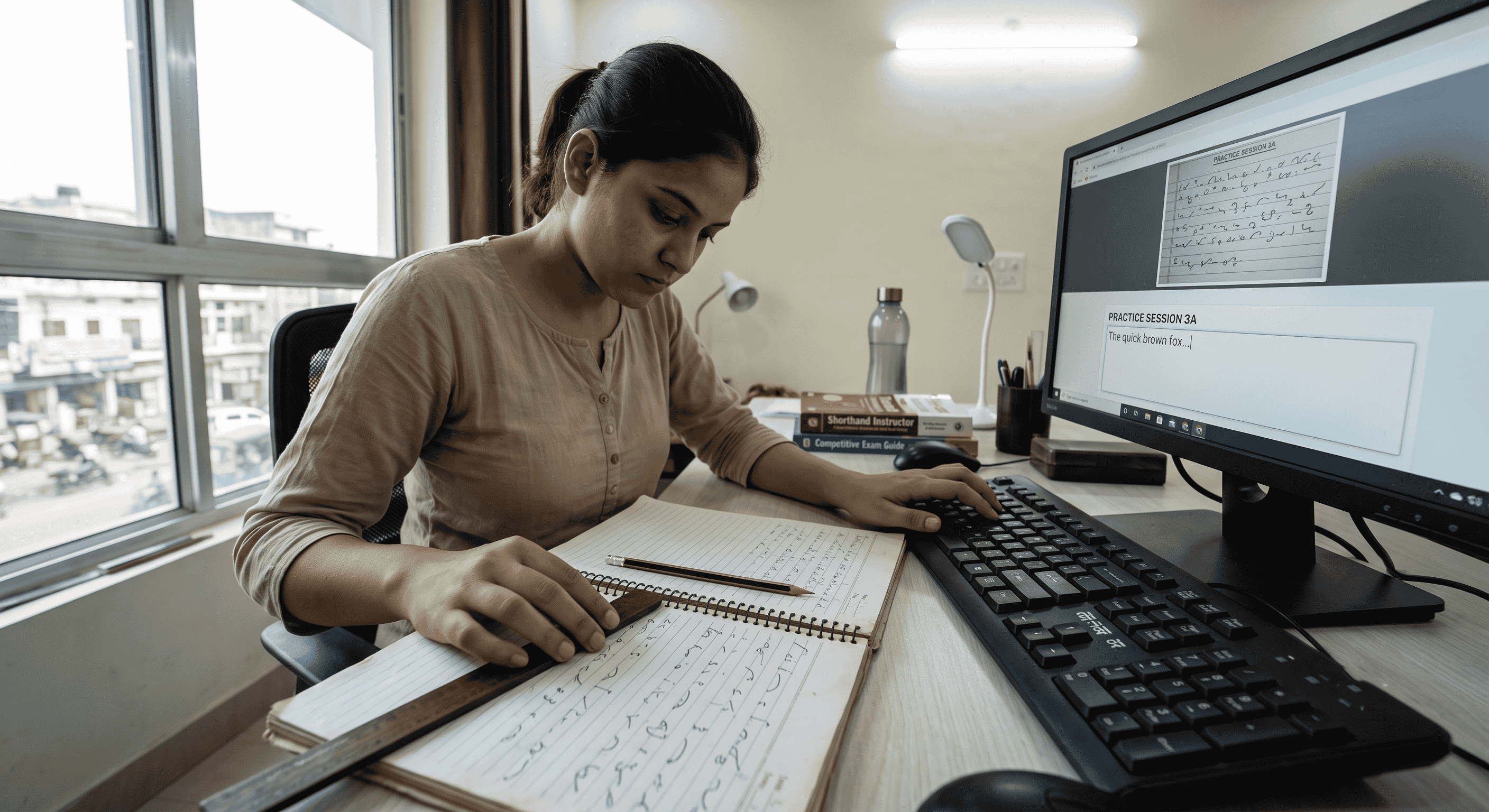
The Computer Based Examination (CBT) for SSC Stenographer 2026 concluded between September 9 and September 15. If you appeared for the exam, you already know the golden rule of stenography selections: the written exam gets your foot in the door, but the skill test decides whether you get the appointment letter.
Waiting for the CBT answer keys or final cutoff marks before picking up your shorthand pencil is the single biggest mistake aspirants make. The gap between CBT results and the physical skill test is notoriously tight. Shorthand is muscle memory, auditory reflex, and cognitive transcription speed rolled into one discipline. You cannot cram an extra 20 words per minute (WPM) into your fingers in two weeks.
Whether you are aiming for Grade C (100 WPM) or Grade D (80 WPM), your immediate post-CBT routine will determine your success. Here is an actionable roadmap to structure your practice, master the transcription phase, and secure your place on the final merit list using the resources at Free Shorthand Typing.
Understanding the SSC Stenographer Skill Test Format
Before designing your training routine, review the official testing parameters. Many candidates build incredible shorthand taking speed but fail during computer transcription because they underestimate formatting rules and time limits.
| Cadre / Grade | Dictation Speed | Dictation Duration | Language | Transcription Time |
|---|---|---|---|---|
| Grade C | 100 WPM (1,000 words total) | 10 Minutes | English | 40 Minutes |
| Hindi | 55 Minutes | |||
| Grade D | 80 WPM (800 words total) | 10 Minutes | English | 50 Minutes |
| Hindi | 65 Minutes |
Important Notice for SSC Aspirants: PwD candidates eligible for a scribe are granted compensatory transcription time (55 minutes for English Grade C, 75 minutes for Hindi Grade C; 70 minutes for English Grade D, and 90 minutes for Hindi Grade D).
Why the Post-CBT Window Is Your Deciding Factor
During CBT preparation, most candidates reduce their daily shorthand writing to one hour or halt it entirely to focus on General Awareness, Reasoning, and English Comprehension. Consequently:
- Hand reflexes slow down.
- Outlines for rare vocabulary become hesitant.
- Reading back your own shorthand cold takes twice as long.
- Typing speed and raw keyboard accuracy drop significantly.
Rebuilding your rhythm takes 10 to 14 days of structured dictation. The sooner you reset your daily schedule to full-fledged government exam preparation mode, the higher your chances of keeping your error percentage well below the 5%–7% qualifying threshold.
Core Pillars of Skill Test Preparation
1. Revitalize Pitman Shorthand Foundations
Speed stalls when foundations crack. If an unfamiliar word appears in the middle of a 100 WPM dictation and you pause for half a second to think about the outline, you miss the next four words. Devote the first 45 minutes of your morning to:
- Reviewing Pitman shorthand grammalogues, logograms, and phraseography.
- Practicing standard joins and intersections (e.g., departmental names, committee titles, parliamentary terms).
- Running focused Pitman exercise drills from standard volumes to reinforce vowel indications and positioning rules.
2. Diverse Shorthand Dictation Regimes
Never practice exclusively with crisp, perfectly articulated audio files. In the actual SSC examination hall, acoustics vary, room echo can occur, and speaker cadence shifts. To bulletproof your performance:
- Vary Your Speeds: If preparing for Grade D (80 WPM), take dictations at 85 to 95 WPM. If aiming for Grade C (100 WPM), push your ceiling to 110–115 WPM. When you practice above exam speed, actual exam dictations feel relaxed.
- Mix Your Sources: Rotate between parliamentary debates (such as the Kailash Chandra compilations), legal proceedings, budget addresses, and newspaper editorial commentaries.
- Practice via Free Shorthand Typing: Access verified shorthand dictation audio modules paired with instant reference outlines to streamline your daily transcription checks.
Never transcribe a passage immediately after taking the dictation. Spend 8 to 10 minutes reading through your shorthand notes with a pencil in hand. Underline ambiguous strokes, insert missing full-stop signs, and decode rough joins while the audio context is still fresh in your mind. This single habit eliminates up to 40% of transcription typos.
3. Computer Transcription & Typing Accuracy
Writing shorthand notes is only 50% of the battle; the software grades what you type on the screen. A brilliant shorthand writer with sluggish keyboard skills will run out of time during computer transcription.
- Benchmark Your Typing Speed: You need a sustained raw typing speed of at least 40–45 WPM in English and 35 WPM in Hindi. This ensures you complete your draft transcription with 10 to 12 minutes left for line-by-line proofreading.
- Focus on Typing Accuracy Over Speed: In the SSC evaluation system, missing punctuation, capitalization errors, spelling slips, repeated words, and dropped paragraphs count as full or half mistakes.
- Script Specifics for Hindi Aspirants: Ensure you are clear about your font and layout requirements. Whether you rely on Kruti Dev typing or Mangal typing (using Remington Gail or Inscript layouts), maintain consistent practice on the exact keyboard layout you selected in your SSC application.
Structured Daily Post-CBT Timetable (6-Hour Plan)
Treat your preparation like a full-time job. Here is an optimized daily routine tested by top-ranking SSC Stenographers:
- Morning Session (07:30 AM – 09:30 AM): Outline Drills & Speed Building
Warm up with basic stroke sets and contractions. Take two 5-minute unmanaged speed bursts at 10 WPM higher than your target. Take one full 10-minute trial dictation at target speed. Read it back aloud entirely.
- Mid-Day Session (11:00 AM – 01:00 PM): Full Mock Transcription
Simulate official exam conditions. Take an unknown 10-minute audio dictation. Immediately sit at your computer, set the official timer (40–65 minutes depending on cadre and language), and transcribe the passage completely. Use our online typing practice tools to check errors automatically.
- Afternoon Session (03:00 PM – 04:15 PM): Keyboard & Font Mastery
Focus purely on raw keyboard mechanics. Take multiple 10-minute sessions on an English typing test or Hindi typing test module. If you are preparing concurrently for judicial or high court exams, incorporate Allahabad High Court formatting drills, focusing on indentation, tabular text, and quotation blocks.
- Evening Session (06:00 PM – 07:15 PM): Error Analysis & Vocabulary Bank
Review the errors from your mid-day mock test. Did you drop words due to speed? Did you misspell common homophones (e.g., their/there, council/counsel)? Copy every troublesome outline 20 times into a dedicated vocabulary diary.
Common Mistakes That Cost Candidates Their Selection
Every year, candidates scoring 150+ in the CBT get disqualified in the skill test due to avoidable technical and procedural habits. Avoid these critical pitfalls:
- Ignoring Keyboard Hardware: Never practice on a soft, shallow-travel laptop keyboard. The examination center will provide standard, high-travel external desktop keyboards (TVS, HP, Dell, or ProDot). Practice on a budget external membrane keyboard to build strong finger endurance.
- Hesitating on Difficult Words: If you do not know the exact shorthand outline for an uncommon proper noun or technical word, write a simplified phonetic outline or skip it immediately. Pausing to construct a complex outline breaks your rhythm and causes you to lose the next 10 words.
- Skipping the Proofreading Window: Many students type until the final countdown second. Plan your transcription pace so that you have 8 to 10 minutes to verify your typed screen text against your physical notebook.
- Relying on Spell-Check: Turn off spell-check and auto-correct extensions in your practice software. The exam interface has zero auto-correction features.
How Free Shorthand Typing Elevates Your Preparation
Preparing at home without expensive coaching institutes is completely achievable with the right ecosystem. At Free Shorthand Typing (freeshorthandtyping.com), we provide an all-in-one platform built specifically for Indian government job aspirants:
- Curated Audio Dictations: Progressive speed sets from 70 WPM up to 120 WPM across general, parliamentary, and legal domains.
- Interactive Typing Tests: Integrated typing evaluation modules supporting both English and Hindi (including Kruti Dev typing and Mangal typing layouts).
- Targeted Skill Alignment: Practice modules tailored for SSC Stenographer Grade C & D, state public service commissions, and court examinations requiring Allahabad High Court formatting standards.
- Detailed Progress Tracking: Monitor your real-time typing accuracy, word counts, and error percentages against official SSC evaluation rules.
Frequently Asked Questions (FAQs)
1. When will the SSC Stenographer 2026 Skill Test take place?
Historically, the Staff Selection Commission conducts the skill test approximately 2 to 3 months after the conclusion of the CBT. For the September 2026 examination cycle, candidates should expect the skill test in late November or December 2026.
2. What is the permissible error percentage in the SSC Steno Skill Test?
Generally, the permissible error margin is up to 5% for General/UR category candidates in Grade C (7% for reserved categories). For Grade D, the margin is up to 7% for General/UR candidates (10% for reserved categories). However, you should always target an error rate below 3% in home practice to maintain a safe cushion.
3. Can I clear the 80 WPM skill test starting from scratch after the CBT?
If you have never learned shorthand strokes, clearing 80 WPM in 60–75 days is exceptionally difficult. However, if you already have basic knowledge of the theory and can write at 50–60 WPM, dedicated full-time practice of 6 to 8 hours daily can comfortably elevate you to exam-ready speeds.
4. How are mistakes evaluated in the SSC Stenographer Skill Test?
SSC classifies mistakes into Full Mistakes (omission of words, substitution of words, addition of words not in the text) and Half Mistakes (spelling errors, capitalization mistakes, incorrect punctuation, singular/plural discrepancies). The total penalty percentage is deducted from your overall word count.
5. Which font will be provided for Hindi transcription in SSC Steno?
SSC supports standard Hindi fonts and layouts on its examination systems, primarily Inscript and Remington Gail on the Mangal font. Verify your preferred option during the candidate portal selection or application form review.
6. Is backspace allowed during computer transcription in the exam?
Yes, standard editing keys including Backspace, Delete, and arrow keys are fully functional during the transcription window on your allocated computer terminal.
7. What pencil and notepad should I use for shorthand practice?
Use standard top-spiral shorthand notebooks with wide-ruled lines and high-grade 2B or specialized steno pencils (e.g., Apsara Stenographer pencils). Avoid rollerball or gel pens unless you are an advanced practitioner, as pencil lead responds better to line thickness variations required for Pitman shading.
8. How can I balance Grade C and Grade D practice simultaneously?
Focus your speed building on Grade C targets (100–105 WPM). If you can accurately capture and transcribe a 100 WPM dictation, an 80 WPM Grade D dictation will feel much slower and easier to manage on exam day.
Conclusion
The post-CBT window is not a break; it is the proving ground where government steno jobs are won. Put away the speculative cutoff videos, open your shorthand pad, sharpen your pencils, and start building disciplined transcription habits today.
Leverage the free exercises, audio tracks, and typing consoles available at Free Shorthand Typing. Every passage you write, decode, and transcribe brings you one step closer to your final appointment order.
Ready to Benchmark Your Shorthand & Typing Speed?
Practice daily dictations, hone your transcription accuracy, and take simulated SSC typing tests for English and Hindi on India's dedicated steno platform.
Start Free Shorthand & Typing Practice NowPopular Tags:
- SSC Stenographer 2026
- Skill Test Preparation
- Shorthand Dictation
- Pitman Shorthand
- Typing Test
- Free Shorthand Typing
- Grade C Stenographer
- Grade D Stenographer
- Typing Speed
- Typing Accuracy
- English Shorthand
- Hindi Shorthand
- Mangal Typing
- Kruti Dev
- Online Typing Practice
- Stenography Mistakes
- Allahabad High Court Formatting
- Government Exam Preparation
- Steno Transcription
- Speed Building