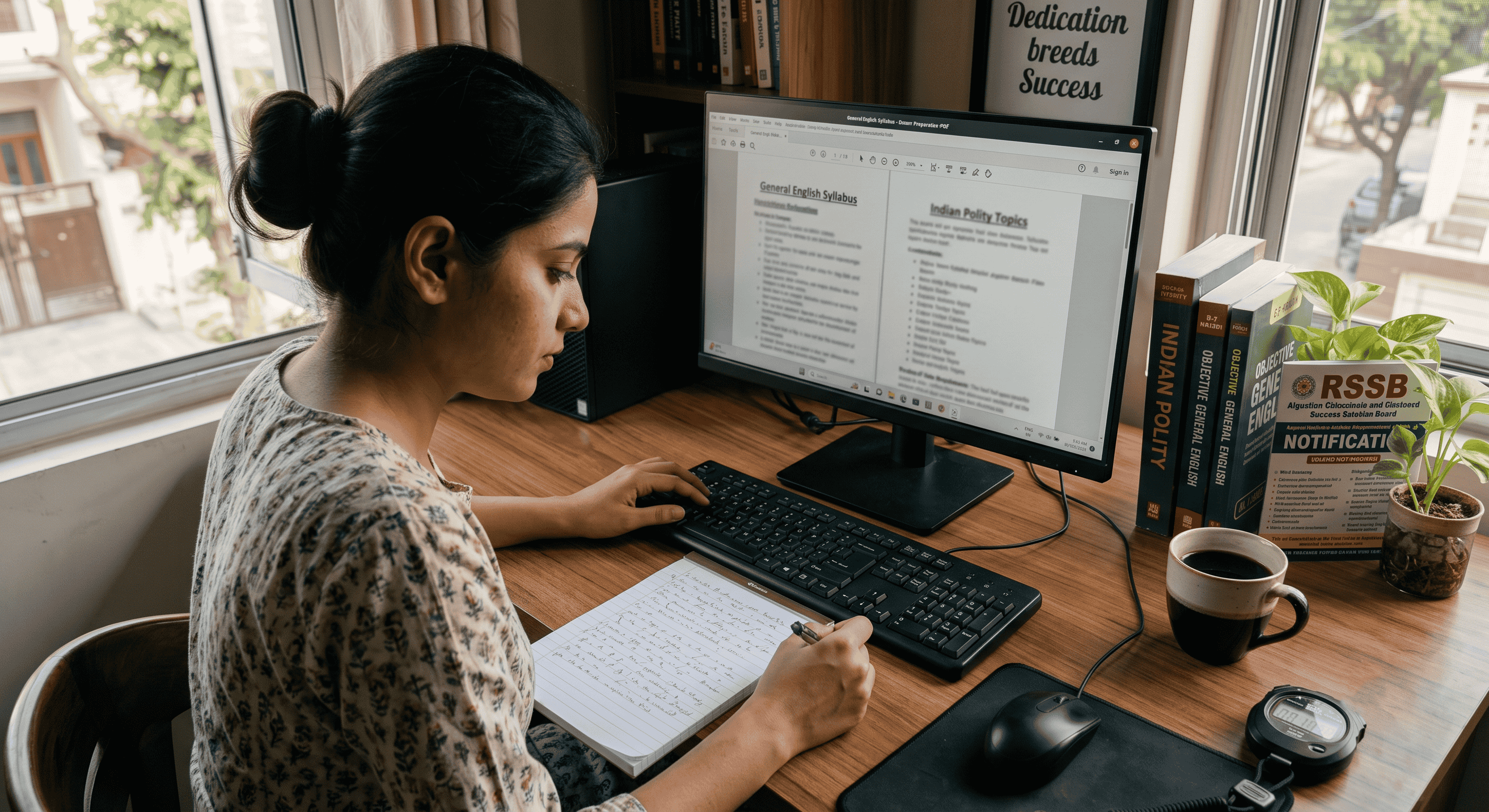
SSC Stenographer Daily Practice Plan: 2 Hours to Skill Test Ready
Clearing the written exam for the SSC Stenographer Grade C and D is a massive achievement. However, as every serious aspirant knows, the real challenge lies ahead: the skill test. Many students panic as the dates approach, assuming they need to practice for eight to ten hours a day to build their speed. In reality, stenography is about muscle memory, cognitive processing, and consistent repetition. Mindless, exhausted practice actually leads to more errors.
If you are preparing for government typing exams, what you need is a highly structured, scientifically backed routine. Welcome to the ultimate 2-hour daily practice plan designed to make you skill-test ready. Whether you are learning English shorthand or preparing for a Hindi typing test, this comprehensive guide will help you optimize your time, build raw typing speed, and maintain pinpoint typing accuracy.
Why a Structured 2-Hour Plan Matters
In the world of government exam preparation, burnout is a real threat. A targeted two-hour block ensures that your brain operates at peak concentration. Shorthand dictation requires intense auditory processing and instant physical translation. If you practice when you are mentally fatigued, your outlines become sloppy, and your transcription suffers.
By breaking your practice down into a focused 120-minute daily session, you build sustainable habits. This approach allows you to seamlessly integrate your online typing practice into your daily schedule without overwhelming your routine, ensuring steady progress right up until the exam day.
Benefits of This Daily Routine
- Prevents Mental Burnout: Short, intense bursts of focus are better for retaining Pitman shorthand rules than long, exhausting sessions.
- Builds Muscle Memory: Consistent daily repetition ensures your fingers know exactly where to go, reducing reliance on the backspace key.
- Improves Typing Accuracy: By dedicating a specific time block strictly to error analysis, you fix mistakes before they become ingrained habits.
- Adapts to Exam Conditions: Practicing in timed blocks simulates the real SSC Stenographer and Allahabad High Court skill test environments.
The Ultimate 2-Hour SSC Stenographer Daily Practice Plan
Below is the step-by-step breakdown of how you should spend your 120 minutes every single day. This routine works whether you are preparing for an English Typing Test, Kruti Dev Typing, or Mangal Typing.
| Phase | Activity | Duration | Primary Goal |
|---|---|---|---|
| Phase 1 | Warm-up & Pitman Exercise | 20 Minutes | Fingers & Mind Activation |
| Phase 2 | Shorthand Dictation | 30 Minutes | Speed Building & Outline Clarity |
| Phase 3 | Transcription / Typing Test | 45 Minutes | Typing Speed & Formatting |
| Phase 4 | Evaluation & Error Checking | 25 Minutes | Typing Accuracy & Mistake Correction |
Phase 1: Warm-up & Pitman Exercise (20 Minutes)
Never jump straight into a high-speed dictation. Your hands and brain need to synchronize. Spend the first 10 minutes doing basic keyboard warm-ups on a platform like Free Shorthand Typing. Focus purely on rhythm rather than raw speed.
For the next 10 minutes, practice your basic Pitman exercise outlines. Write down grammalogues, common phrases, and difficult words from yesterday's session. If you are a Hindi stenography student, this is the time to warm up your fingers with complex joint letters and Alt codes used in Kruti Dev or Mangal Unicode typing.
Phase 2: Shorthand Dictation (30 Minutes)
This is the core of your shorthand practice. Select an audio dictation that is 5 to 10 words per minute (WPM) faster than your current comfortable speed. If you comfortably write at 80 WPM, challenge yourself with an 85 or 90 WPM audio file.
- Take a 10-minute continuous dictation.
- Do not stop writing, even if you miss a word. Keep your pen moving.
- Take a 5-minute break to rest your wrist.
- Take a second 10-minute dictation at your comfortable target speed (e.g., exactly 80 WPM or 100 WPM for Grade C).
Phase 3: Transcription and Typing Test (45 Minutes)
Reading your notes and typing them into a computer is where most students fail the SSC Stenographer exam. Take your notes from Phase 2 and begin your online typing practice.
Set a timer for 40 minutes (the standard time for SSC Grade D English transcription) and type out your notes. Treat this exactly like the real exam. Do not look at your keyboard. Whether you are using standard English or focusing on Allahabad High Court formatting rules, ensure your paragraphs, indentations, and punctuation are flawless.
Phase 4: Evaluation and Error Checking (25 Minutes)
Practicing without evaluation is a waste of time. Once your typing test is complete, calculate your errors. Look for:
- Omissions: Words you missed during the dictation.
- Substitutions: Words you misread from your own shorthand outlines.
- Typographical Errors: Spelling mistakes made during transcription.
Circle the shorthand outlines that you misread and write them correctly 10 times in your notepad. This guarantees you won't make the same mistake tomorrow.
Practical Examples: Setting Up Your Session
Imagine you are an SSC Grade D aspirant aiming for 80 WPM in English. Your practical setup should look like this: You sit at your desk at 7:00 AM. By 7:20 AM, you have warmed up your fingers and practiced your grammalogues. From 7:20 to 7:50 AM, you plug in your earphones and take dictations from the Free Shorthand Typing audio library. From 7:50 to 8:35 AM, you transcribe your notes on the computer software, strictly avoiding distractions. Finally, from 8:35 to 9:00 AM, you match your typed text with the original PDF script, calculating your exact error percentage.
During your transcription phase, use a basic, slightly stiff desktop keyboard rather than a sleek laptop keyboard. Government exam centers rarely have premium keyboards. Adapting to clunky keys at home will save you from panic on exam day.
Common Mistakes to Avoid in Skill Tests
- Obsessing Over Speed, Ignoring Accuracy: Typing at 50 WPM with 10% errors will fail you, while typing at 35 WPM with 2% errors will pass you. Typing accuracy is the ultimate deciding factor.
- Looking at the Screen While Reading Notes: Train your eyes to stay glued to your shorthand notepad. Looking back and forth between the screen and the pad causes you to lose your place and wastes precious seconds.
- Failing to Practice Formatting: Exams like the Allahabad High Court require specific formatting. Pressing the spacebar multiple times instead of using the 'Tab' key for paragraph indents can lead to automated point deductions.
- Stopping When a Word is Missed: In dictation, if you miss a word, leave a blank space and catch up to the speaker. Pausing to remember a lost word will cause you to miss the next entire sentence.
Frequently Asked Questions
1. How many hours a day should I practice shorthand for SSC Stenographer?
Quality beats quantity. A highly focused 2 to 3-hour daily routine involving dictation, transcription, and error analysis is much more effective than practicing aimlessly for 8 hours.
2. Should I learn Kruti Dev or Mangal typing for government exams?
It depends on the specific exam notification. SSC Stenographer generally allows Mangal (Inscript/Remington CBI), while some state exams specifically ask for Kruti Dev Typing. Always check the official notification before starting your preparation.
3. How is the error percentage calculated in the SSC skill test?
Errors are categorized into full mistakes (omission of words, substitution of words, adding extra words) and half mistakes (spelling errors, capitalization errors, punctuation errors). The total errors are calculated against the total number of words dictated.
4. Is 40 WPM typing speed enough for SSC Grade D?
Yes, for Grade D, you are given 50 minutes to transcribe 800 words in English, which mathematically requires a typing speed of just 16 WPM. However, maintaining a speed of 30-40 WPM gives you ample time to format and review your work.
5. Can I use the backspace key during the SSC Stenographer skill test?
Yes, the backspace key is fully functional and allowed during the SSC Stenographer transcription test. However, over-relying on it slows down your overall transcription time.
6. How can I improve my reading speed of Pitman shorthand notes?
The best way to improve reading speed is to read your notes aloud immediately after the dictation finishes, before you begin typing. Also, ensure your light and heavy strokes are clearly distinct when writing.
7. Are online typing tests accurate for exam preparation?
Yes, using dedicated portals like Free Shorthand Typing accurately simulates the exam interface, providing realistic timer conditions and automated error calculations based on government exam formulas.
8. What is the difference between an English Typing Test and a transcription test?
A standard typing test requires you to copy text directly from a screen or paper. A transcription test requires you to translate your own handwritten shorthand symbols into typed text, which requires higher cognitive effort.
Final Conclusion
Success in the SSC Stenographer skill test does not happen by accident. It is the result of deliberate, daily, and disciplined practice. By dedicating just two hours a day to this four-phase plan—warm-up, dictation, transcription, and evaluation—you will build the muscle memory and mental stamina required to conquer the exam hall.
Remember that government exam preparation is a marathon, not a sprint. Focus on your Pitman shorthand basics, never compromise on typing accuracy just to feel fast, and most importantly, evaluate your mistakes daily.
Ready to Transform Your Practice?
Stop guessing your typing speed and error rates. Join Free Shorthand Typing today to access premium shorthand dictations, authentic exam-level online typing practice, and instant error calculation.
Popular Tags:
- SSC Stenographer
- Skill Test Preparation
- Shorthand Strategy
- Typing Speed
- Pitman Shorthand
- Government Jobs
- Steno Practice
- Typing Accuracy
- Daily Routine
- Exam Tips
- Hindi Typing
- English Typing
- Court Stenographer
- Dictation Practice
- SSC Grade C
- SSC Grade D
- Transcription
- Error Calculation
- Typing Test Online
- Study Plan.