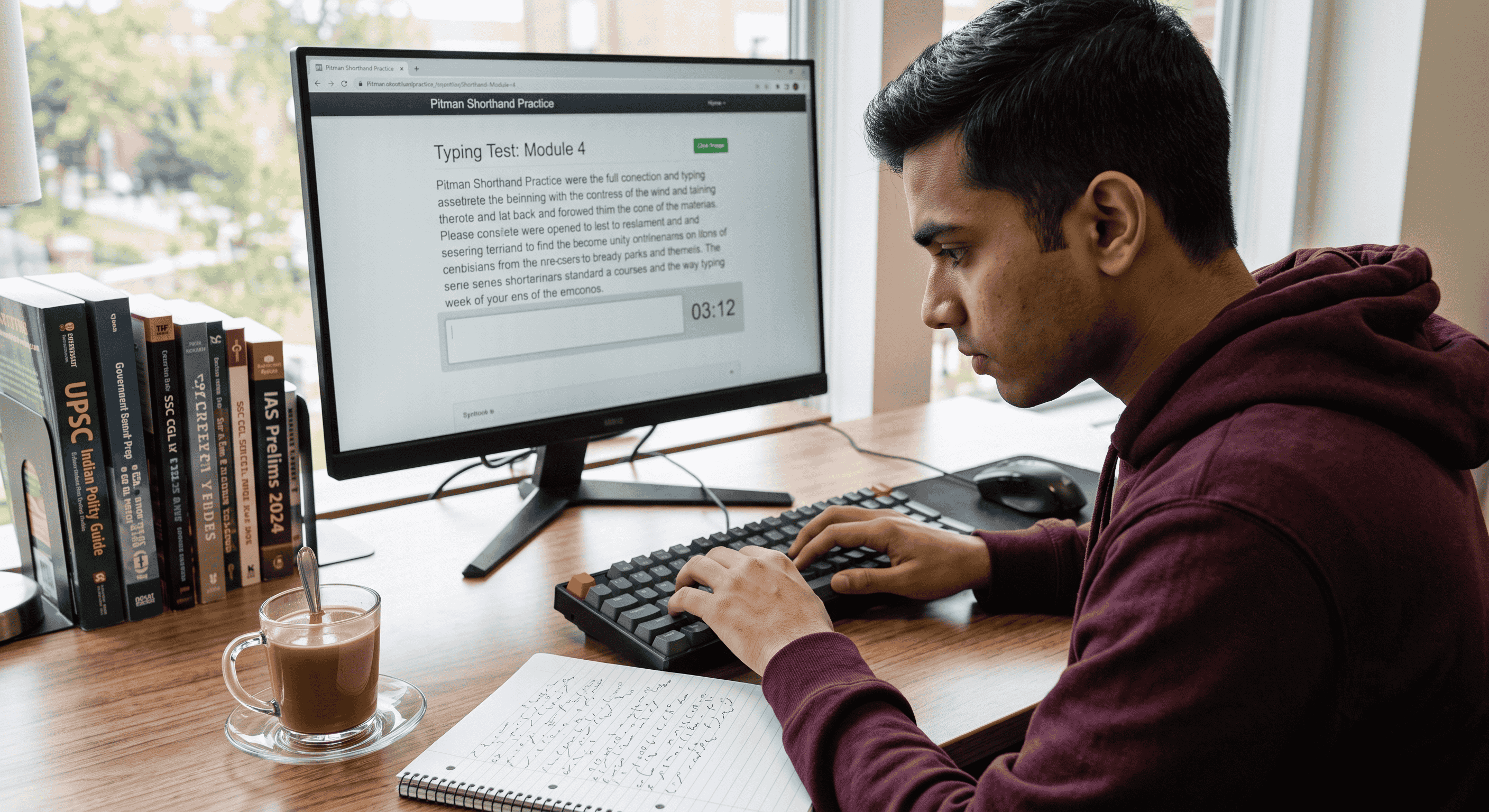
The Art of Reading "Cold Notes": Strategies for Flawless Shorthand Transcription
You have just finished a gruelling 100 WPM Shorthand Dictation. The speaker stops, the timer ends, and you let out a long breath. You survived the speed. But then, you look down at your notepad. What started as beautiful, textbook-perfect Pitman Shorthand on page one has slowly devolved into hurried slashes, distorted curves, and missing vowels by page five.
Welcome to the real test of a stenographer: transcription. Taking the dictation is only half the battle. The true measure of your Government Exam Preparation is your ability to read what you wrote, especially when those notes go "cold."
Cold notes are shorthand outlines that you are reading minutes, hours, or even days after you wrote them, long after your short-term memory of the audio has faded. Mastering the art of reading these messy outlines is the secret weapon for clearing the SSC Stenographer exam, cracking the High Court skill test, and achieving 100% Typing Accuracy.
Why Reading Cold Notes Matters
Many beginners spend all their time pushing their Shorthand Dictation speed from 60 WPM to 80 WPM, and then to 100 WPM. They assume that if they can write it down, they can type it out. This is a fatal flaw in Government Exam Preparation.
When you are in the examination hall, nerves and adrenaline change your handwriting. Your strokes get larger, your light and heavy strokes blend together, and your halving and doubling principles get sloppy. If you rely solely on your memory of the dictation to fill in the blanks, you will fail the final Typing Test. You must train your brain to decode the structural logic of rushed outlines.
The Benefits of Mastering Cold Note Transcription
- Higher Typing Accuracy: When you aren't guessing words, your error rate drops dramatically.
- Uninterrupted Typing Speed: Hesitation destroys typing speed. Reading ahead smoothly keeps your fingers moving steadily, whether you are taking an English Typing Test or a Hindi Typing Test.
- Reduced Exam Anxiety: Knowing you can read your own messy handwriting gives you massive confidence during the actual dictation phase.
- Versatility: It prepares you for strict evaluation standards, including Allahabad High Court Formatting, where precision is everything.
Step-by-Step Guide: How to Transcribe Messy Outlines
When staring down a page of difficult notes, follow this systematic approach to decode them without panicking.
Step 1: The Three-Second Pre-Read
Before you place your hands on the keyboard to start your Online Typing Practice or exam transcription, take a few seconds to scan the first paragraph. Do not start typing immediately. Establish the context, the tense (past, present, future), and the subject matter of the passage. Context is your greatest ally when deciphering a broken outline.
Step 2: Rely on Consonant Skeletons
At high speeds, you will drop almost all vowels. You are left with the "skeleton" of the word—the consonants. If you see a stroke that looks like "P-R-V-D", your brain needs to instantly cycle through possibilities based on context: "provide," "provided," "pervade," "proved."
Step 3: Analyze the Position
In Pitman Shorthand, position writing (above the line, on the line, through the line) is often the only thing separating two identical consonant outlines. If your notes are messy, check the baseline. Did you intend for that stroke to cross the line? If a messy outline sits above the line, prioritize first-position vowels (ah, aw, a, o) when guessing the word.
Step 4: Use Grammatical Logic
If you cannot read a word, look at the word before it and the word after it. English grammar rules will eliminate 90% of incorrect guesses. For example, if the preceding word is an article ("the," "a," "an"), the messy outline must be a noun or an adjective. If the preceding word is "has" or "have," the messy outline is likely a past participle verb (often ending in -ed).
Maintaining Stroke Proportion Under Pressure
The main reason notes become unreadable is a loss of proportion. Here is how to fight back during high-speed dictation.
| Shorthand Principle | What Happens Under Pressure | How to Fix It |
|---|---|---|
| Light vs. Heavy Strokes (e.g., P vs. B, T vs. D) | Everything becomes a medium, uniform thickness due to a heavy hand. | Use a high-quality shorthand pencil (like Apsara Steno) and grip it loosely. Let the pencil do the work, not your wrist. |
| Halving Principle (adding T or D) | Half-strokes stretch out and look like full strokes. | Exaggerate your full strokes. Make normal strokes slightly longer so your half-strokes clearly look half-sized by comparison. |
| Doubling Principle (adding tr, dr, thr) | Double strokes shrink and look like normal strokes. | Sweep the pen boldly. A double stroke should take up almost two line spaces. |
| Hooks (R, L, N, F/V) | Small hooks become large circles; large hooks close up entirely. | Practice hook drills specifically. When writing fast, flick the wrist sharply at the start or end of the stroke. |
Practical Examples: Deciphering Tricky Outlines
Let’s look at a common scenario in an SSC Stenographer skill test. You encounter a hurried outline that looks like a sloppy "M-N".
- Scenario A: The sentence reads, "The government has taken a decision in this ___." Given the context, the sloppy "M-N" is almost certainly "matter" (M doubled for 'tr'). Your halving/doubling was just messy.
- Scenario B: The sentence reads, "He is a very good ___." Here, the "M-N" is likely "man."
By relying on sentence structure rather than staring blankly at the isolated stroke, you keep your Typing Speed up and avoid wasting precious minutes.
Common Transcription Mistakes Costing You Marks
- Stopping at the Hard Word: The worst thing you can do during a Typing Test is stop typing for two minutes to stare at one bad outline. Type a placeholder (like an asterisk or a blank space), continue transcribing the rest of the sentence, and come back. Often, finishing the paragraph provides the context needed to figure out the missing word.
- Ignoring Singular/Plural Context: A tiny, missed 'S' circle at the end of an outline is the most common error in shorthand. Always check the verb agreement. If the sentence is "The boy are playing," you missed the 'S' circle on "boy". It must be "boys". This simple grammatical check saves massive points in error calculation.
- Mixing up Hindi Fonts: For those attempting a Hindi Typing Test, misreading your shorthand can lead to disaster if you are also fighting your keyboard. Whether you use Kruti Dev Typing or Mangal Typing, ensure your phonetic understanding of the shorthand matches the exact keystrokes required.
How Free Shorthand Typing Helps Your Preparation
At Free Shorthand Typing, we understand that passing the exam requires a complete ecosystem. Practicing every day on our platform allows you to:
- Access graded Pitman Exercise audio files at varying speeds.
- Take a dedicated Typing Test immediately after your dictation to simulate exam conditions.
- Practice strict Allahabad High Court Formatting rules right in your browser.
- Build muscle memory for both English and Hindi keyboard layouts.
Frequently Asked Questions (FAQ)
1. How soon should I transcribe my notes after a dictation?
In the beginning stages, transcribe immediately while the memory is fresh. As you approach exam level, intentionally wait 1 to 2 hours before transcribing. This trains you to read the physical outlines rather than relying on short-term memory.
2. What should I do if I completely miss a sentence during dictation?
Do not panic and do not stop writing. Leave a noticeable gap on your notepad and jump right back in with the current word the speaker is saying. Missing a few words is a half-mistake or full mistake; stopping entirely will cost you the whole paragraph and fail you the exam.
3. How can I improve my shorthand reading speed?
Read your notes aloud. Every time you finish a practice dictation, read the entire shorthand passage out loud with a timer before you start typing. Aim to read your shorthand notes at the same speed you read normal English text.
4. Does the SSC Stenographer exam penalize for formatting?
The SSC evaluates primarily on word accuracy, spelling, and omissions. However, exams like the Allahabad High Court are incredibly strict on formatting, paragraph indentations, and capitalization. Always practice according to the specific exam's notification.
5. How do I fix my messy halving and doubling principles?
Go back to basics. Dedicate 15 minutes a day strictly to practicing paired words slowly (e.g., pen/print, make/matter). Focus purely on proportion, not speed. Muscle memory built slowly translates to accuracy at high speeds.
6. Should I use a pen or a pencil for shorthand exams?
Most professionals and exam bodies recommend a high-quality shorthand pencil. Pencils provide natural friction that helps control stroke length and makes it much easier to distinguish light and heavy strokes without applying excessive pressure.
7. What if my English grammar is weak?
You must improve it. Shorthand transcription is 50% reading outlines and 50% applying grammatical logic to figure out missing vowels and poorly written strokes. Read English newspapers daily to build your contextual guessing ability.
8. Can I clear the exam if my cold notes are always messy?
Messy is okay; inaccurate is not. As long as your "messy" notes retain structural integrity (correct position, correct base consonants, correct hooks), you can clear the exam. Focus on writing readable skeletons rather than beautiful artwork.
Conclusion
Transcribing shorthand is a distinct skill from writing it. Reading "cold notes" requires patience, grammatical knowledge, and the ability to stay calm under pressure. By focusing on consonant skeletons, relying on sentence context, and practicing delayed transcription, you will transform messy pages into a flawless final document.
Your notebook is your source code; learning to read it perfectly is the key to unlocking your career as a stenographer. Don't let a poorly written outline ruin months of hard work. Train your eyes to be as fast as your hands.
Ready to test your transcription skills?
Stop practicing blindly and start practicing smart. Join thousands of successful candidates at Free Shorthand Typing today. Take a free Shorthand Dictation, instantly test your transcription on our advanced Typing Test engine, and track your Typing Accuracy. Your government job is just a few perfect keystrokes away.
Popular Tags:
- Shorthand Transcription
- Cold Notes
- Pitman Shorthand
- SSC Stenographer
- Shorthand Dictation
- Typing Accuracy
- Typing Speed
- Government Exams
- High Court Stenographer
- Skill Test Preparation
- English Typing
- Hindi Typing
- Shorthand Practice
- Stenography Tips
- Exam Strategy
- Dictation Decoding
- Outline Proportion
- Messy Notes
- Transcription Strategies
- Free Shorthand Typing.