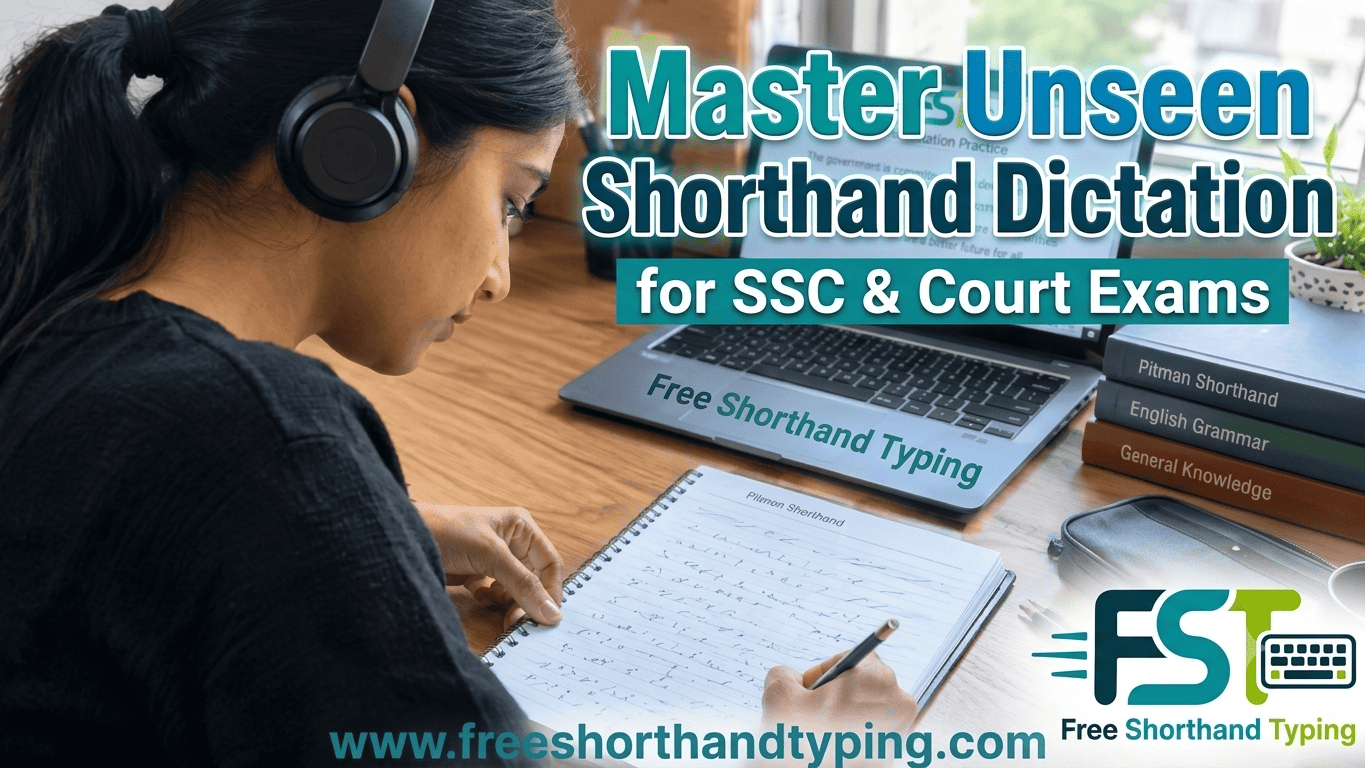
How to Practice Unseen Shorthand Dictation for SSC and Court Exams
If you are deeply invested in Government Exam Preparation, specifically aiming for a stenographer position, you already know that clearing the computer-based written test is just the beginning. The ultimate hurdle—and the one that eliminates the most candidates—is the skill test. Whether you are targeting SSC Stenographer Grade C and D, or a highly coveted position within the judiciary like a Court Stenographer, the final challenge comes down to one thing: accurately transcribing an unseen dictation passage under immense pressure.
Many students type flawlessly and write beautiful shorthand outlines when practicing familiar passages at home. However, the moment they sit in the exam hall and hear unfamiliar vocabulary, their hands freeze. At Free Shorthand Typing, we have guided thousands of aspirants through this exact bottleneck. This comprehensive, step-by-step guide will break down exactly how to transition from familiar drills to mastering unseen passages, ensuring you walk into your skill test with absolute confidence.
What is Unseen Dictation, and Why Does it Matter?
Unseen dictation refers to an audio passage delivered at a continuous, steady speed (typically 80 WPM or 100 WPM) that you have absolutely no prior exposure to. In real-world skill tests, the dictated matter is completely fresh. It could be an excerpt from a recent parliamentary debate, a complex legal judgment, a presidential address, or an editorial piece from a national newspaper.
Why is this the gold standard for testing? Because a professional stenographer's daily job involves recording live, unpredictable human speech. The evaluators use unseen dictation to test your real-time cognitive processing, your deeply ingrained knowledge of Pitman Shorthand rules, and your ability to construct readable outlines on the fly without panicking or dropping the context of the sentence.
How Unseen Dictation Differs from Repeated or Familiar Dictation
When you practice the same Pitman Exercise or Kailash Chandra transcription repeatedly, your brain builds localized muscle memory. You start anticipating the upcoming words, and your hand glides across the steno pad effortlessly. While this is fantastic for initial confidence and learning phrasing, it creates a dangerous illusion of mastery.
- Familiar Dictation: Relies heavily on memory rather than active listening. It involves high confidence and often results in artificially inflated writing speeds because there is zero hesitation in outline construction.
- Unseen Dictation: Requires intense, active cognitive processing. You must simultaneously listen to a new word, recall or invent the shorthand outline, write it down legibly, and stay ready for the next word—all in a fraction of a second.
If your entire routine consists of practicing familiar passages, an unseen passage will cause cognitive overload. You will hesitate on a new word, miss the next five words, and the entire transcription will fall apart.
Choosing Appropriate Dictation Speeds: 60, 80, 100 WPM and Beyond
To conquer unfamiliar passages, you need to scale your speed strategically. Forcing yourself to take a 100 WPM unseen dictation when you just finished your basic theory will only lead to frustration and bad habits.
- 60 WPM (The Foundation Phase): If you have just completed your shorthand theory book, start here. At 60 WPM, your brain has a split second to recall outline placement (above the line, on the line, through the line) and vowel sounds. It builds a bedrock of accuracy.
- 80 WPM (The SSC Grade D Standard): This is the benchmark for SSC Grade D and numerous subordinate court exams. Your primary focus here is continuous writing. You must train yourself not to stop completely when a difficult word appears.
- 100 WPM (The SSC Grade C & High Court Standard): At this advanced speed, phrasing becomes your lifeline. You simply cannot write every word individually. Grouping phrases like "I am directed to state" or "as far as possible" into a single, flowing outline is mandatory.
- 110 - 120 WPM (The Buffer Zone): You should always practice 10 to 20 WPM above your actual exam speed. Exam anxiety naturally slows down your reflexes. If your exam target is 100 WPM, practicing unseen dictations at 110 WPM will make the actual 100 WPM test feel incredibly slow, clear, and manageable.
A Step-by-Step Method for Attempting an Unfamiliar Passage
Approaching a brand-new dictation requires a disciplined, systematic strategy. Incorporate these exact steps into your daily practice routine:
Step 1: The Blind Attempt
Play the audio of an unseen passage without looking at the PDF transcript beforehand. Put your phone away and do not pause or rewind the audio under any circumstances. If you miss a word or a phrase, leave a small gap on your notepad and catch the very next word immediately. The absolute priority is keeping your hand moving.
Step 2: The Crucial Reading Phase
As soon as the dictation audio ends, do not immediately rush to your computer keyboard. Take 5 to 10 minutes to silently read through your shorthand notes. Use a pencil to lightly insert English or Hindi translations above highly distorted outlines. Mentally fill in the blank spaces where you dropped words by using the grammatical context of the sentence.
Step 3: The Timed Transcription
Open your text editor or an Online Typing Practice software and start typing. Set a strict countdown timer. Treat this exactly like the real skill test. Whether you are taking an English Typing Test or a Hindi Typing Test, avoid hitting the backspace key excessively, as it destroys your overall Typing Speed.
Step 4: The Brutal Evaluation
Once time is up, compare your typed document line-by-line with the original transcript. Be ruthless in your checking. A missed article ("a", "an", "the") is an error. A misplaced comma that changes capitalization is an error. This is the only way to improve.
How to Check Your Transcript and Classify Mistakes
To measure genuine progress, you must evaluate your work exactly the way the SSC and High Court examiners do. In the stenography world, mistakes are universally classified into Full Mistakes and Half Mistakes.
| Mistake Type | Description / SSC Rules | Practical Examples |
|---|---|---|
| Full Mistake | Omission of a dictated word, substitution of a dictated word with a totally wrong word, or addition of an extra word that was never dictated. | Writing "boy" instead of "man". Skipping the word "government". Adding "the" where it doesn't belong. |
| Half Mistake | Spelling errors, capitalization errors (e.g., not capitalizing proper nouns), and singular/plural errors. | Writing "affect" instead of "effect". Writing "boy" instead of "boys". Writing "india" instead of "India". |
Your goal during daily practice is to keep your total error percentage below 5% (the standard cutoff for general categories in SSC exams).
Pro Tip: Typing Test Platforms Matter
If you are preparing for regional or state court exams, ensure you are practicing on the exact keyboard layouts prescribed in the notification. For Hindi stenographers, mastering Kruti Dev Typing or Mangal Typing (Inscript/Remington) is non-negotiable. Furthermore, understanding strict formatting rules—like Allahabad High Court Formatting, which involves specific paragraph indentations and spacing—can save you from losing massive marks on otherwise perfect transcriptions.
Building a Robust Shorthand Vocabulary
Unseen dictations are terrifying mostly because of unknown words. You can overcome this by actively expanding your shorthand vocabulary. Dedicate 20 minutes daily to reading English or Hindi newspapers (like The Hindu or Dainik Jagran). Pick out 10-15 complex words, legal terms, or proper nouns. Look up their correct standard outlines in a shorthand dictionary, and practice them for five lines each until they become pure muscle memory.
A Seven-Day Unseen Dictation Practice Schedule
Consistency is the ultimate secret to shorthand success. Here is a balanced, highly effective weekly routine to help you conquer unfamiliar dictations without burning out.
- Monday (Endurance Day): Take two unseen dictations at your target speed. Focus strictly on finishing the passage without giving up, even if you miss a few words.
- Tuesday (Accuracy Day): Take a dictation 10 WPM slower than your target (e.g., 70 WPM if your goal is 80 WPM). Aim for 98% to 100% accuracy. Focus on perfect outlines.
- Wednesday (Vocabulary Building): Isolate all the difficult words you dropped on Monday and Tuesday. Drill their outlines repeatedly.
- Thursday (Speed Push): Take an unseen dictation 10 to 15 WPM faster than your target exam speed. Do not worry about transcription accuracy today; just train your hand to move faster.
- Friday (Specialized Matter): Step away from parliamentary debates. Practice a court judgment, legal dictation, or a scientific passage to expose yourself to highly formal terminology.
- Saturday (Full Mock Test): Create exam-like conditions. One 10-minute unseen dictation, 10 minutes of reading time, and timed typing. Evaluate strictly based on the half/full mistake rules.
- Sunday (Rest & Review): Rest your hands. Analyze your week's mistakes. Are you losing marks to spelling errors? Missed words? Bad formatting? Adjust next week's focus accordingly.
Measuring Improvement in Outlines, Accuracy, and Speed
Shorthand progress can feel slow. How do you actually know you are getting better? Look for these three undeniable signs:
- Fewer Dropped Words: Over a month, you will notice your hand stops freezing when you hear a complex word. You will start creating logical, phonetic outlines intuitively rather than panicking.
- Improved Transcription Time: If it initially took you 60 minutes to type an 800-word dictation, watch that time drop to 40 minutes as your Typing Accuracy improves and you spend less time agonizing over poorly written outlines.
- Lower Error Percentage: Maintain a dedicated progress diary. Log your error count after every mock test. A steady drop from 8% down to 4% is concrete proof that your unseen dictation practice is paying off.
Common Mistakes Aspirants Must Avoid
- Stopping for one missed word: If you miss a word, let it go immediately. Stopping to remember it will cost you the next 10 words, ruining the entire paragraph.
- Not transcribing on a computer: Simply writing shorthand notes and never typing them out is the biggest mistake you can make. Reading shorthand is a completely different skill from writing it.
- Ignoring punctuation during dictation: Failing to mark full stops (using the small cross in Pitman) will make it impossible to know where a sentence ends, leading to massive capitalization errors during typing.
Frequently Asked Questions (FAQs)
1. When should I start practicing unseen dictations?
You should introduce unseen dictations as soon as you have completed your core shorthand theory book and can comfortably write and read familiar passages (like simple Pitman exercises) at 60 WPM.
2. I freeze completely when I hear a hard word. What should I do?
Train yourself to write based on phonetics. Even if you only write the first consonant stroke and a vowel, put it down and move on. The grammatical context of the sentence will usually help you guess the exact word during transcription.
3. Is the dictation in the SSC Stenographer exam completely unseen?
Yes, the passage is 100% unseen and undisclosed. It is typically sourced from recent parliamentary debates, presidential speeches, budget sessions, or editorial articles from major newspapers.
4. How much time is given to read the shorthand notes before typing?
In most government skill tests, including the SSC Stenographer exam, you are granted a 10-minute reading window immediately after the dictation ends, right before you are instructed to start typing on the computer.
5. For Hindi stenography, should I practice on Mangal or Kruti Dev?
This strictly depends on the official exam notification. SSC generally provides software that allows both Mangal (Inscript and Remington CBI) and Kruti Dev. However, many State High Courts strictly require either Kruti Dev Typing or Mangal Typing exclusively. Always read the notification carefully before beginning your typing practice.
6. Does punctuation count as a mistake in SSC skill tests?
SSC usually does not penalize heavily for minor comma variations, but missing full stops is disastrous. If you miss a full stop, the next word will not be capitalized, which counts as a half mistake. If missing the full stop changes the sentence's structural meaning, it can compound into multiple errors.
7. How can I build my legal shorthand vocabulary for Court exams?
Download previous years' Supreme Court and High Court judgments. Practice the common legal phrases (e.g., "learned counsel for the appellant," "jurisdiction of this court," "writ petition"). Create specific shortcuts for these heavy phrases.
8. What is the standard transcription time given for 80 WPM and 100 WPM tests?
For SSC Grade D (80 WPM, 800 words), candidates get 50 minutes for English transcription and 65 minutes for Hindi. For SSC Grade C (100 WPM, 1000 words), candidates get 40 minutes for English and 55 minutes for Hindi.
9. Should I use a pencil or a pen for shorthand?
It is highly recommended to use a standard shorthand pencil (like Apsara Steno or Nataraj) because Pitman shorthand requires distinguishing between light and heavy strokes. Pens make it very difficult to differentiate between thick and thin strokes at high speeds.
10. Will practicing on a normal keyboard affect my exam performance?
Yes. Try to practice on a standard, slightly elevated mechanical or membrane desktop keyboard, similar to what you will find in government exam centers. Avoid practicing your final Typing Test on flat laptop keyboards.
Final Conclusion
Conquering unseen dictation is the definitive bridge between being a shorthand learner and becoming a professional, job-ready stenographer. It tests your nerves, your vocabulary, and your transcription accuracy all at once. By stepping out of your comfort zone, embracing the struggle of unfamiliar passages, and strictly evaluating your mistakes, you will dramatically improve both your Typing Speed and your shorthand reliability.
Do not wait for the exam dates or admit cards to be announced before starting your unseen dictation practice. Begin today. Set up a quiet environment, grab your steno pad, and challenge yourself with new audio passages daily.
Ready to take your skills to the next level? Head over to the practice section at Free Shorthand Typing for high-quality audio dictations at multiple speeds, accurate transcripts, and our premium Online Typing Practice tools designed specifically for Shorthand Dictation aspirants. Keep practicing, stay consistent, and secure that dream government job!
Popular Tags:
- Unseen Dictation
- SSC Stenographer
- Court Stenographer
- Shorthand Practice
- Pitman Shorthand
- Typing Accuracy
- Skill Test
- Free Shorthand Typing
- Government Jobs
- Transcription
- Steno Speed
- Legal Dictation
- English Typing
- Hindi Typing
- Allahabad High Court
- Shorthand Mistakes
- 80 WPM
- 100 WPM
- Steno Preparation
- Skill Test Strategy