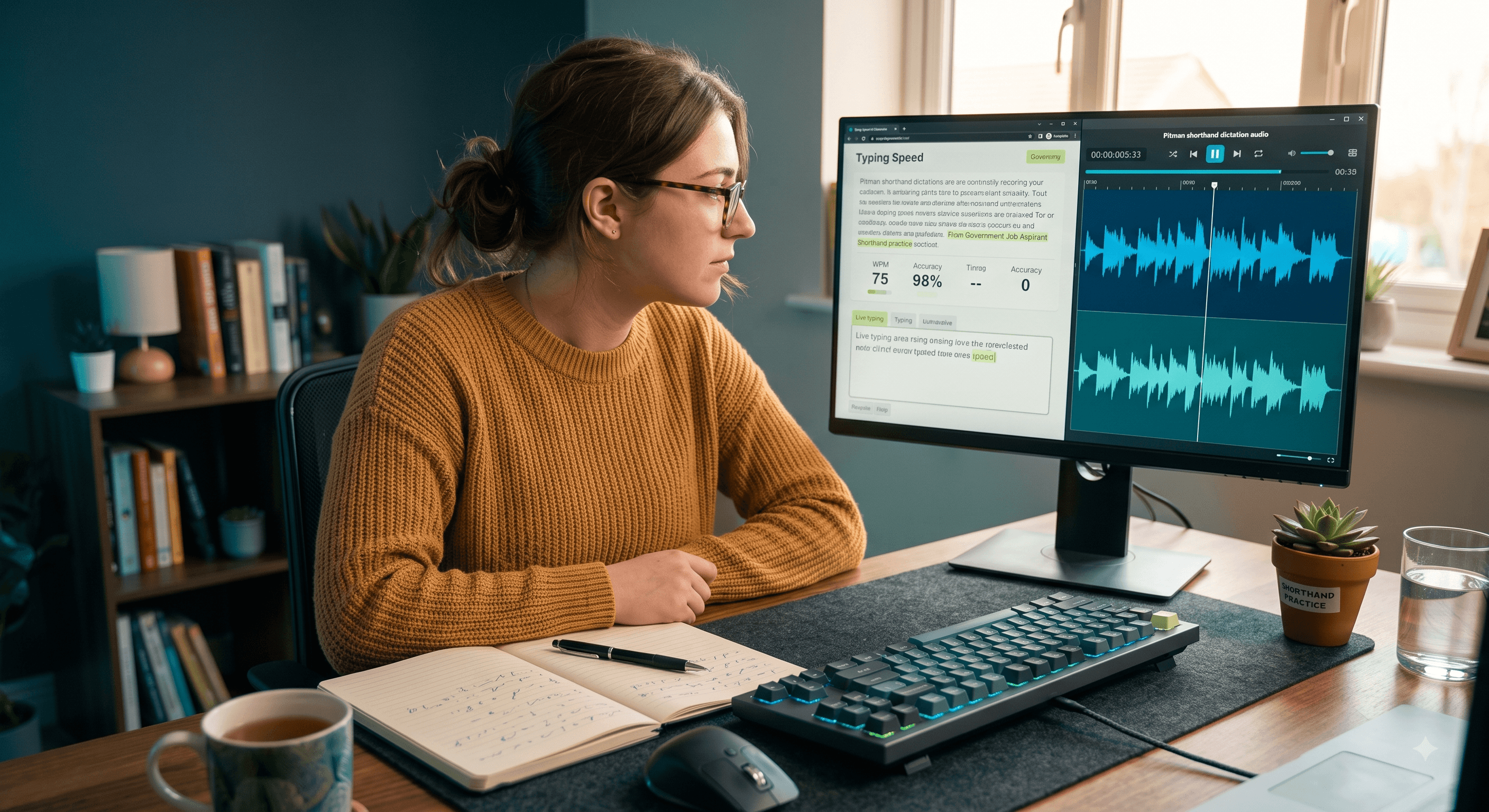
Mastering Shorthand Dictation and Typing Speed for Government Exams
Securing a post as an SSC Stenographer, Court Reporter, or Assistant Section Officer requires mastering a skill test that blends active listening, motor mechanics, language comprehension, and spatial accuracy under timed pressure. While written examinations evaluate general intelligence and subject knowledge, skill tests measure practical, real-time performance on computer terminals. For candidates preparing for recruitment exams conducted by the Staff Selection Commission (SSC), High Courts, and Railway Recruitment Boards (RRB), shorthand dictation and typing tests represent the final barrier between preparation and final selection.
Every year, thousands of aspirants score high marks in written tests only to fail the shorthand skill test or typing qualification. These failures rarely stem from a lack of effort; they result from fragmented practice routines, poor posture, and inaccurate finger placement. Mastering Pitman Shorthand and building exceptional Typing Speed requires systematic training, consistent feedback, and targeted error correction.
Key Strategies for Peak Exam Performance
- Maintain Home Row Discipline: Always anchor your fingers on the A-S-D-F and J-K-L-; keys to build effortless touch typing muscle memory.
- Master Font Requirements: Understand the exact font standards before taking your exam. SSC examinations primarily use Mangal Typing Unicode layouts (Remington Gail or Inscript), whereas state judicial tests frequently require legacy Kruti Dev Typing.
- Focus on Net Speed and Accuracy: High gross speed is meaningless if uncorrected keystrokes push your error percentage past allowable thresholds. SSC rules strictly penalize omissions, substitutions, and punctuation errors.
- Practice Phraseography: Joining multiple shorthand outlines without lifting your pen is the most effective technique for bridging the speed gap between 80 WPM and 100+ WPM during live dictation.
Daily Preparation Roadmap
- Spend 30 minutes practicing basic home-row keystrokes and character isolation drills on https://freeshorthandtyping.com Free Shorthand Typing.
- Take down 10 minutes of live audio dictation at your target speed (80 or 100 WPM).
- Spend 5 minutes reading through your shorthand outlines before transcribing them onto the computer terminal.
- Analyze your automated error report to identify recurring spelling, spacing, or layout mistakes.
Consistency is key. Start your transcription routine early, practice under timed test conditions, and turn your skill test into your strongest asset.
Popular Tags:
- SSC Stenographer
- Pitman Shorthand
- English Typing
- Hindi Typing
- Kruti Dev
- Mangal Font
- Allahabad High Court
- Typing Test
- Shorthand Dictation
- Typing Speed
- Typing Accuracy
- Online Typing Practice
- Government Exams
- Steno Skill Test
- Remington Gail
- Inscript
- Court Stenographer
- Shorthand Exercises
- Touch Typing
- Error Calculation.