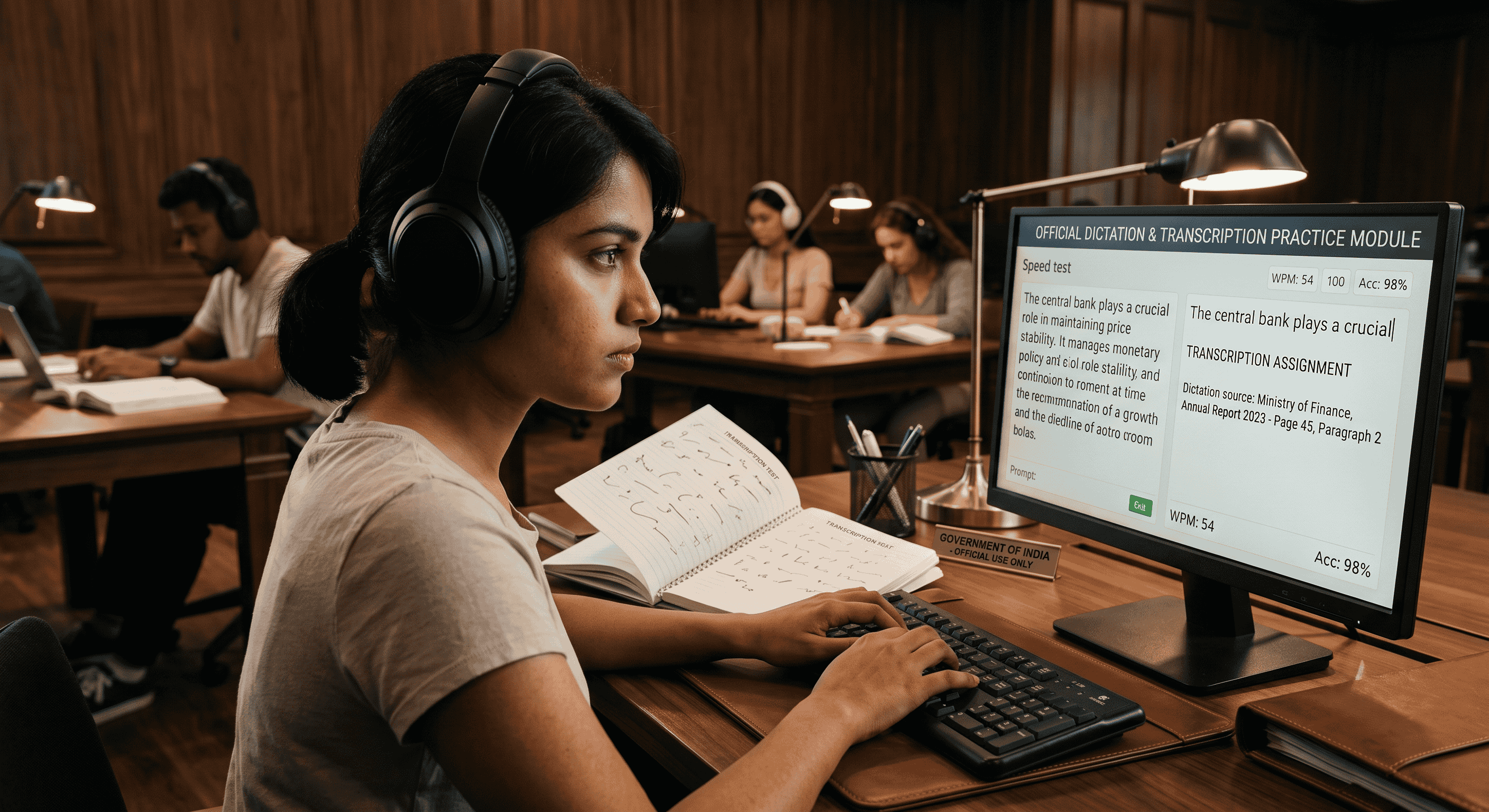
Master Mental Buffering: How to Handle Speed Fluctuations During Shorthand Dictation
If you have ever prepared for a government skill test, you know the drill. You practice religiously with audio tracks set at exactly 80 or 100 Words Per Minute (WPM). You feel confident. Your outlines are clean. But then, exam day arrives. The speaker steps up to the microphone, and reality hits you. Human beings do not speak at a flat, robotic pace. They pause for breath, they slow down for complex legal terms, and they suddenly speed up to finish a sentence before taking another breath. This sudden burst of speed is exactly where most stenography students panic, drop words, and lose their chance at clearing the exam.
Welcome to the realities of live Shorthand Dictation. To survive and thrive in exams like the SSC Stenographer or court tests, you need a secret weapon: Mental Buffering, also known as word retention.
In this comprehensive guide by Free Shorthand Typing, we will explore the cognitive angle of stenography. We will teach you how to hold words in your short-term memory so you never panic when the dictator hits the accelerator. Whether you are practicing Pitman Shorthand or preparing for a high-stakes Hindi Typing Test, mastering this skill will transform your exam performance.
Why Dictator Speed Fluctuations Matter
When you use Online Typing Practice platforms or standard audio files, the pacing is often mathematically divided. If the test is 100 WPM, the software spaces out exactly 25 words every 15 seconds. However, in a real exam hall for Government Exam Preparation, a human dictator might speak 15 words in the first 10 seconds, pause for 2 seconds, and then rush through 20 words in the remaining 3 seconds.
If you are writing word-for-word exactly as you hear it (zero buffer), that sudden 3-second rush will overwhelm your physical writing speed. You will tense up, your outlines will become messy, and you will miss entire phrases. Understanding that speed fluctuations are normal is the first step to conquering them.
What is Mental Buffering (Word Retention)?
Mental buffering is the cognitive ability to listen to the dictator, store a "buffer" of 5 to 10 words in your short-term memory, and write them down a few seconds after they were spoken, all while continuously listening to the new words being spoken.
Think of it like streaming a video on YouTube. The video player downloads (buffers) a few seconds of video ahead of what you are actually watching. This ensures that if your internet connection suddenly slows down, the video does not pause. In stenography, your brain is the video player. By keeping a buffer of words in your head, you can maintain a steady physical writing pace even when the speaker's voice speeds up or slows down.
The Benefits of Mastering Mental Buffering
- Panic Prevention: You will no longer freeze when the dictator speaks a long, rapid sentence.
- Cleaner Outlines: Because you are writing at a steady, controlled pace rather than rushing, your Pitman Exercise outlines remain accurate and readable.
- Higher Transcription Accuracy: Clean outlines lead directly to better Typing Accuracy when you sit down for the actual Typing Test.
- Better Phrasing: When you hold a whole sentence in your head, you can naturally combine words into advanced shorthand phrases (e.g., "it is not necessary"), which saves vital time.
Step-by-Step Guide to Building Your Mental Buffer
Developing word retention is a cognitive muscle that must be trained. Here is a step-by-step method to build your buffer.
- The Echo Technique: Start your Shorthand Dictation audio. Do not write immediately. Let the speaker say three words, and then start writing. Force yourself to always stay exactly three words behind the speaker.
- Increase the Gap: Once three words feel comfortable, increase the gap to five words, then seven words. It will feel uncomfortable at first, like your brain is splitting in two directions. This means it is working.
- Practice with Varied Pacing: Stop practicing exclusively with robotic audio. Use live speeches, news broadcasts, or specifically designed fluctuating dictations available on the Free Shorthand Typing platform.
- Focus on Meaning, Not Just Sounds: It is much easier to remember a 7-word phrase if you understand the context. Instead of hearing isolated sounds, listen to the meaning of the sentence. "The judge dismissed the appeal today" is easier to retain as a single concept than six random words.
- Master Breathing: When the dictator speeds up, your instinct is to hold your breath. This spikes anxiety. Train yourself to exhale slowly when a burst of speed occurs. Keep your hand moving steadily.
Practical Examples: Buffering in Action
Let us look at a standard sentence you might encounter while practicing Allahabad High Court Formatting or legal dictations:
"The petitioner has submitted that the documents were forged."
| Technique | What the Speaker Says | What You Are Writing (The Delay) | Result if Speaker Speeds Up |
|---|---|---|---|
| No Buffer (Novice) | "The petitioner..." | Writing "The petitioner..." simultaneously. | Hand cramps, messy outlines, dropped words. |
| 3-Word Buffer (Intermediate) | "...has submitted that..." | Writing "The petitioner has..." | Can handle mild fluctuations but may struggle with long rushes. |
| 7-Word Buffer (Expert) | "...the documents were forged." | Writing "...has submitted that the..." | Smooth writing, perfect outlines, zero panic. |
Common Mistakes to Avoid
- Chasing the Speaker: Trying to write faster to "catch up" to the speaker's exact current word. Trust your memory buffer instead.
- Abandoning Difficult Outlines: If you hear a hard word, you might freeze, trying to remember the stroke. This destroys your buffer. Just write the phonetic sounds or first letter, leave a space, and keep moving.
- Only Practicing at Target Speeds: If your goal is 80 WPM, you should be doing dictations at 90 WPM and 100 WPM. Over-speed training forces your brain to develop a buffer naturally.
- Ignoring Language Skills: Good English or Hindi grammar helps you predict what word is coming next, reducing the load on your short-term memory.
Pro Tip for SSC and High Court Aspirants
Whether you are facing an English Typing Test, a Kruti Dev Typing exam, or Mangal Typing, your typing speed cannot save you if your shorthand notes are unreadable. Spend 20% of your daily practice time purely on "delayed writing" drills where you do not pause the audio, no matter how far behind you fall. Train the mind first, and the hand will follow.
Frequently Asked Questions (FAQs)
1. What is mental buffering in shorthand?
Mental buffering is the cognitive ability to hold 5 to 10 spoken words in your short-term memory while simultaneously writing down the previous words during a dictation.
2. Why do dictators fluctuate their speed during exams?
Human speech naturally involves pauses for breathing and emphasis, followed by rapid speech to finish thoughts. In exams like the SSC Stenographer, dictators are often reading live, making natural human speed variations unavoidable.
3. How many words should I aim to keep in my buffer?
A safe and effective buffer for an expert stenographer is between 5 to 8 words. This provides enough cushion to survive a sudden burst of rapid speech.
4. Does mental buffering help with Typing Speed?
Indirectly, yes. Mental buffering leads to highly accurate, well-formed shorthand outlines. When you sit down for your Typing Test, you can read your notes instantly without hesitation, which significantly boosts your transcription Typing Speed.
5. Can I practice buffering with Hindi dictations?
Absolutely. The cognitive process is exactly the same whether you are preparing for a Hindi Typing Test or English. Word retention works regardless of the language.
6. What if I forget the words in my buffer?
If you drop a word, do not stop to think about it. Leave a small gap in your notes and immediately focus on the words the dictator is currently saying. You can often guess the missing word later based on the context of the sentence.
7. How long does it take to develop a strong mental buffer?
With consistent, focused daily practice using the "echo technique," most students begin to see significant improvements in their word retention within 3 to 4 weeks.
8. Where can I find fluctuating dictations to practice?
You can use the advanced dictation tools available on the Free Shorthand Typing platform, which are specifically designed to simulate real-world exam hall conditions.
Final Conclusion
Surviving a shorthand skill test is not just about moving your pencil fast; it is about keeping your mind calm and organized. Dictation speed fluctuations are a guaranteed part of exams like the SSC Stenographer and High Court tests. By intentionally training your brain to utilize mental buffering and word retention, you transform sudden bursts of speed from a source of panic into a manageable routine.
Remember, the goal is not to write at exactly the same second the word is spoken. The goal is to capture the complete dictation accurately. Train your brain to hold the words, let your hand glide steadily across the paper, and your results will speak for themselves when it is time to transcribe.
Call to Action
Are you ready to test your mental buffering skills under real exam conditions? Stop relying on flat, predictable audio tracks. Join Free Shorthand Typing today to access premium Shorthand Dictation exercises, realistic mock exams, and comprehensive typing software supporting Kruti Dev Typing, Mangal Typing, and English formats. Create your free account now and take the first step toward clearing your government skill test with absolute confidence!
Popular Tags:
- Shorthand Dictation
- Mental Buffering
- Speed Fluctuations
- Word Retention
- SSC Stenographer
- Skill Test
- Pitman Shorthand
- Typing Accuracy
- Government Exams
- Court Stenographer
- Memory Techniques
- Dictation Strategy
- Steno Prep
- Shorthand Speed
- Exam Day Tips
- Online Typing Practice
- Shorthand Focus
- Steno Students
- Dictation Audio
- Skill Test Preparation