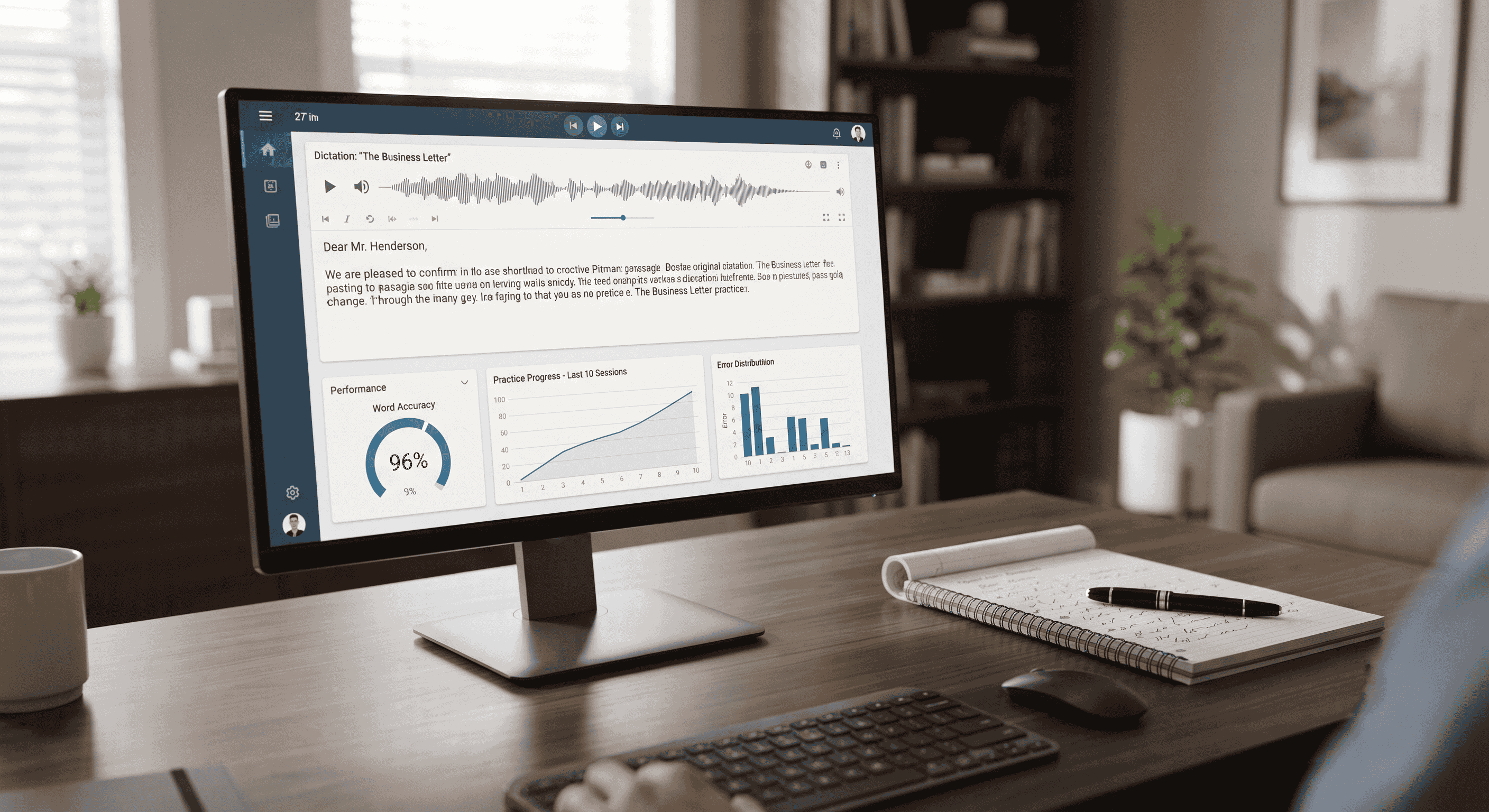
Introduction: Decoding the Black Box of Skill Test Evaluation
For thousands of aspirants preparing for government jobs through the Staff Selection Commission (SSC), Allahabad High Court (AHC), and various state tribunals, the typing and shorthand skill test remains the ultimate hurdle. Years of perfecting Pitman shorthand outlines and drilling English and Hindi typing test modules can vanish in minutes if you miscalculate how assessment engines score your performance.
Most candidates assume that typing speed is the only metric that matters. In reality, modern recruitment boards use sophisticated automated evaluation software that rigidly enforces strict penalty formulas. A single misplaced space, a forgotten punctuation mark, or a minor spelling error can trigger a cascade of point deductions. This comprehensive guide breaks down the math behind official error calculation formulas, distinguishes between full and half mistakes, and provides tactical strategies to protect your score on exam day.
Why Understanding Error Calculation Matters for Your Career
Why do brilliant stenography students with lightning-fast shorthand transcription skills often fail? The answer lies in the gap between manual practice and automated scoring. When you practice on generic typing platforms, minor errors are often ignored or highlighted casually. Official government evaluation software, however, operates on rigid algorithms.
Knowing the precise rules of error calculation transforms your approach to daily practice:
- Eliminates False Confidence: You stop celebrating a "clean 90 WPM test" when you realize minor spacing and capitalization errors are secretly dragging your accuracy below the passing threshold.
- Optimizes Risk Management: You learn when it is strategically safer to omit an unreadable shorthand outline rather than guess wildly and trigger multiple penalty points.
- Reduces Test Anxiety: Understanding how mistakes are weighted gives you absolute clarity during the 10-minute transcription window, minimizing panic when you encounter an unfamiliar technical term.
The Core Anatomy of Government Typing Test Penalties
Government skill tests—whether for SSC Stenographer Grade C & D or High Court personal assistant positions—evaluate two primary metrics: Gross Speed and Net Accuracy. While speed gets you through the door, accuracy keeps you on the merit list.
Evaluation software compares your transcribed text against the master passage word-for-word, character-for-character. Every discrepancy is classified into specific error categories. To master this, you must understand the two major tiers of penalties: Full Mistakes and Half Mistakes.
1. Full Mistakes: The Heavy Hitters
A full mistake represents a substantial deviation from the original text that fundamentally alters the meaning, content, or structural integrity of the passage. Each full mistake typically deducts a heavy penalty from your total word count (often equivalent to 5 full words or a direct percentage deduction depending on the board guidelines).
Common triggers for full mistakes include:
- Omission of a word or group of words: Skipping a word entirely during shorthand transcription.
- Substitution of a wrong word: Typing "accept" instead of "except," or replacing a legal term with an incorrect synonym.
- Addition of unauthorized words: Inserting extra words that did not exist in the dictation passage.
- Repetition of words: Typing a phrase twice due to transcription stutter.
- Complete transposition of word sequences: Changing the order of words in a sentence so drastically that the grammar and context break down.
2. Half Mistakes: The Silent Score Killers
Many candidates fail by a fraction of a percent because they underestimate half mistakes. These are minor formatting, punctuation, or typographical errors that do not destroy the entire word but violate strict accuracy rules. Typically, two half mistakes are counted as one full mistake.
Common triggers for half mistakes include:
- Spacing Errors: Leaving double spaces between words or omitting a space after a punctuation mark.
- Capitalization Errors: Failing to capitalize the first letter of a proper noun or sentence, or unnecessarily capitalizing a lowercase word.
- Punctuation Omissions: Missing commas, full stops, quotation marks, or semicolons where specified in the passage formatting rules (especially critical in Allahabad High Court formatting).
- Minor Spelling Variations: Spelling errors that do not completely transform the word into another valid English/Hindi word but violate standard spelling conventions.
The Exact Math Behind Official Evaluation Formulas
To understand how your final score is computed, let’s look at the mathematical framework utilized by most central and state examination boards. While specific weighting can vary slightly between an SSC skill test and a High Court computer proficiency test, the core formula follows a standardized structure.
| Error Category | Definition & Description | Standard Penalty Weight |
|---|---|---|
| Full Mistake | Omission, substitution, addition, or complete reversal of a word. | 1 Full Error (Equivalent to 5 correct words deducted from total) |
| Half Mistake | Spacing, punctuation, capitalization, or minor typographical slip. | 0.5 Error (Two half mistakes equal 1 full mistake) |
| Allowed Mistake Limit | Maximum permissible error percentage (e.g., 5% to 7% for unreserved categories). | Exceeding this limit results in direct disqualification. |
The Basic Accuracy Percentage Formula:
For example, if a dictation passage contains 800 words, and you commit 10 full mistakes (10 points) and 10 half mistakes (5 points), your total penalty score is 15 points. If your raw correct word count is 775, your net effective score is evaluated against the strict threshold. If the board mandates a maximum allowable error rate of 5% (which equals 40 allowed mistakes on an 800-word passage), you safely pass. However, if your penalty points cross that ceiling, you are disqualified regardless of your raw speed.
Step-by-Step Guide to Mastering Error-Free Transcription
Transitioning from a practice environment to exam-hall execution requires a systematic workflow. Follow this step-by-step strategy during your daily practice sessions on platforms like Free Shorthand Typing:
- Active Listening & Outline Verification: During the shorthand dictation phase, focus on crisp, unambiguous Pitman outlines. Never guess an outline while writing; if a word is missed, leave a clean space in your notebook to maintain context.
- Systematic First-Pass Typing: When transcribing your shorthand notes into the computer, type the core text smoothly without pausing to fix every minor typo immediately. Prioritize getting 100% of the words on screen.
- The Review and Polish Phase: Allocate the final 20% of your allotted time specifically for proofreading. Check for punctuation marks, paragraph breaks, and capitalization. This is where you catch half mistakes that cost precious tenths of a percent.
- Font and Layout Compliance: If your exam requires Hindi typing, ensure your keyboard mapping (whether practicing Kruti Dev typing or Mangal Unicode typing) is second nature so your fingers never hesitate on complex half-letters and Alt codes.
💡 Pro Tip: The Golden Rule of Omission vs. Guessing
If you encounter an illegible shorthand outline during transcription, do not guess blindly. A wild guess that results in a wrong word becomes a Full Mistake (substitution). Leaving the word out entirely is also a full mistake, but guessing incorrectly often triggers cascading grammatical errors in the subsequent sentence. When in doubt, evaluate the surrounding context quickly or leave a clean placeholder if permitted by your pacing strategy.
Practical Example: Case Study of an SSC Stenographer Transcript
Let's examine a practical scenario to see how evaluation math works in real life.
Master Passage Sentence: "The committee recommended immediate implementation of the financial policy." (10 words)
Candidate Transcript A: "The committee recommended immediate implementation of the financial policy." (Perfect match: 0 errors)
Candidate Transcript B: "The committee recommended immediate implementation of financial policy." (Missing article "the" = 1 Full Mistake for omission)
Candidate Transcript C: "The Committee recommended immediate implementation of the financial Policy." (Capitalized "Committee" and "Policy" unnecessarily = 2 Half Mistakes = 1 Full Mistake)
Notice how Candidate C lost the exact same number of penalty points as Candidate B simply due to poor capitalization discipline. Small formatting discipline separates qualified candidates from the rest.
Common Mistakes That Destroy Your Skill Test Score
Avoiding avoidable errors is the fastest way to boost your rank. Watch out for these frequent pitfalls:
- Ignoring Formatting Rules: Neglecting indentation, double spacing after full stops, or failing to match Allahabad High Court formatting standards.
- Relying Solely on Speed: Typing at 110 WPM with 85% accuracy will always fail against a candidate typing at 85 WPM with 98% accuracy. Accuracy reigns supreme.
- Panic Backspacing: Spending 30 seconds repeatedly deleting and retyping a single difficult word, thereby sacrificing 15 subsequent words.
- Neglecting Daily Simulated Tests: Practicing raw typing tests without software timers or error-highlighting feedback loops. Always use structured online typing practice tools to simulate exam pressure.
Frequently Asked Questions (FAQs)
1. What is the difference between a full mistake and a half mistake in SSC Stenographer exams?
A full mistake includes word omissions, substitutions, additions, or complete word transpositions. A half mistake covers minor formatting issues like incorrect spacing, missing punctuation marks, or minor capitalization errors. Two half mistakes equal one full mistake.
2. How are spelling mistakes penalized in government typing tests?
Spelling mistakes that change a word into an entirely different valid word are evaluated as full substitution mistakes. Minor typographical typos that maintain readability are often categorized under half mistakes or character-level penalties depending on the specific exam evaluation software.
3. Is it better to skip an unreadable shorthand outline or guess it?
If an outline is completely illegible, guessing blindly risks introducing grammatical errors and cascading wrong words. However, leaving a word blank guarantees an omission error. The best approach is to practice high-speed Pitman shorthand dictation regularly to eliminate illegible outlines altogether.
4. How many mistakes are allowed in the SSC Stenographer skill test?
The permissible error limit varies by category (typically around 5% to 7% for unreserved candidates). Exceeding this threshold results in disqualification, regardless of how fast you completed the dictation transcription.
5. How does Allahabad High Court formatting evaluation differ from SSC?
Allahabad High Court skill tests place heavy emphasis on exact document formatting, paragraph indentation, bold headers, and punctuation marks. Missing specific formatting requirements can incur additional half mistakes even if the text itself is spelled correctly.
6. Can I practice error calculation online before my exam?
Yes! Platforms like Free Shorthand Typing offer dedicated English typing tests, Hindi typing tests, Kruti Dev typing, Mangal Unicode typing, and Pitman exercises with instant accuracy reports that simulate official evaluation metrics.
7. Does capitalization error count as a full mistake?
No. Incorrect capitalization is classified as a half mistake. However, accumulating multiple half mistakes will quickly compound into full error deductions.
8. How can I improve my net accuracy from 90% to 98%?
Dedicate the last 15% of your practice time solely to proofreading. Focus on eliminating extra spaces, verifying punctuation against the master text, and maintaining steady rhythm rather than erratic sprinting.
Final Conclusion
Mastering shorthand dictation and typing speed is only half the battle. To secure your dream government job as an SSC or Court stenographer, you must treat accuracy and error calculation with the same rigor as your Pitman outlines. By understanding the strict mathematical difference between full and half mistakes, eliminating careless formatting slips, and practicing regularly on professional evaluation simulators, you can bulletproof your exam performance.
Ready to Test Your Accuracy?
Take your preparation to the next level. Practice professional shorthand dictations, Pitman exercises, English and Hindi typing tests, and court formatting modules today on Free Shorthand Typing.
Start Free Practice NowPopular Tags:
- Free Shorthand Typing
- Shorthand Dictation
- Typing Test
- Pitman Exercise
- Pitman Shorthand
- SSC Stenographer
- Typing Speed
- Typing Accuracy
- English Typing Test
- Hindi Typing Test
- Kruti Dev Typing
- Mangal Typing
- Allahabad High Court Formatting
- Online Typing Practice
- Government Exam Preparation
- Skill Test Evaluation
- Error Formula
- Full Mistakes
- Half Mistakes
- SSC Steno Exam
- High Court Steno
- Stenography Accuracy
- Typing Penalties
- Transcription Errors
- Exam Preparation
- Typing Rules