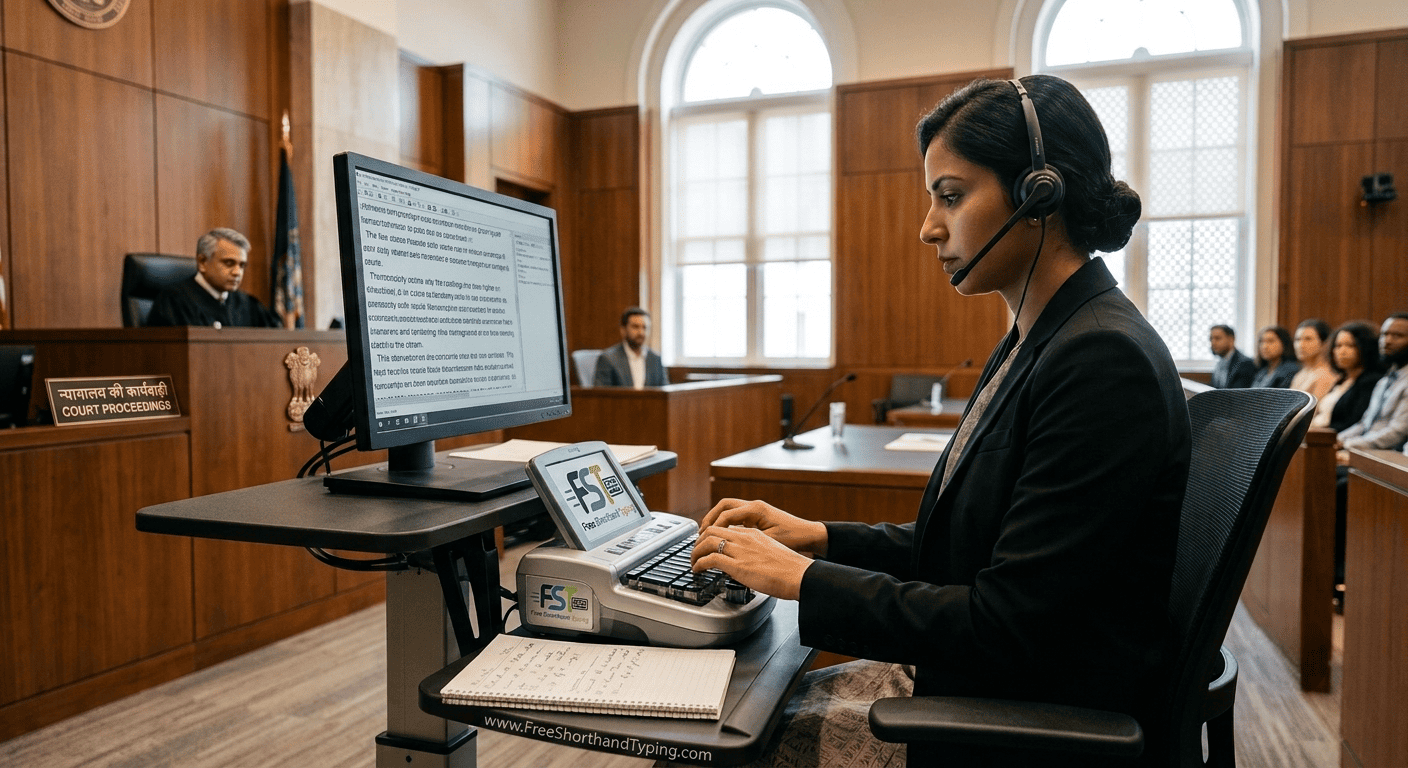
Court Stenographer Recruitment & Career Guidance Focus
Introduction
If you are diving into Government Exam Preparation and possess strong listening and typing skills, a career as a court stenographer might be the perfect fit for you. A court stenographer serves as the silent, essential backbone of the judicial system. They capture the spoken word with complete precision, ensuring that the wheels of justice turn smoothly and accurately. With consistent court stenographer vacancy announcements across various states every year, this career path offers immense job security, social respect, and a highly stable income.
However, many candidates struggle to understand the actual process of getting hired. From figuring out exactly how to become a court stenographer to navigating the complexities of high court stenographer recruitment, the necessary information is often scattered. In this comprehensive guide, we will walk you through the entire recruitment landscape, eligibility criteria, required skills, and a solid preparation roadmap to help you secure your seat in the judiciary.
Why It Matters: The Importance of the Role
In any judicial setting, verbal proceedings need to be converted into written official records accurately and swiftly. This is where shorthand dictation comes in. Judges rely entirely on their stenographers to take down complex judgments, daily orders, and witness testimonies. Any error in transcription can alter the legal meaning of a document, making Typing Accuracy just as critical as Typing Speed. The confidentiality of these documents is also paramount, placing stenographers in a position of immense trust within the legal system.
Benefits of Choosing this Career
- Unmatched Job Security: Being a permanent government job, it offers unparalleled job security and stability until retirement.
- Financial Stability: Excellent pay scales under state and central government pay commissions, alongside inflation-adjusted allowances like DA and HRA.
- Predictable Career Progression: Clear promotion pathways from Junior Stenographer all the way to Private Secretary.
- Respectable Work Environment: Working directly alongside judges and senior legal officers places you in an elite, intellectual professional environment.
What is a Court Stenographer?
A court stenographer is a specialized professional responsible for recording spoken words during legal proceedings using a shorthand system—most commonly Pitman Shorthand. Their daily tasks involve taking dictation from judges, which can include final judgments, daily case orders, and administrative memos. They must then transcribe those notes into a readable, properly formatted legal document using a computer.
The role spans across district courts, High Courts, tribunals, and other judicial institutions. Beyond simply typing, the job requires a high degree of discretion and confidentiality, as stenographers handle sensitive legal decisions before they are officially pronounced in open court. A deep understanding of legal terminology, correct punctuation, and specific regional formats—like Allahabad High Court Formatting—is often necessary for long-term success.
Court Stenographer Recruitment Routes
Securing a position requires knowing exactly where to look. Recruitment does not happen through a single central agency; rather, it is divided among several authorities. Knowing how to track a court stenographer vacancy is half the battle won.
- High Courts: High court stenographer recruitment is conducted independently by each state's High Court. For example, the Delhi High Court stenographer recruitment process has its own specific official notification, syllabus, and skill test standards. Notifications are published directly on the official High Court websites.
- District Judiciary / Subordinate Courts: In many states, district court recruitment is centralized by a state-level recruitment board, a subordinate selection commission, or the High Court itself. These vacancies are typically higher in number and happen more frequently.
- SSC Stenographer: The Staff Selection Commission (SSC) conducts national-level exams for Grade C and Grade D stenographers. While these positions are primarily for central government ministries, many candidates are posted in legal offices and tribunals under the central government.
- Tribunals and Legal Institutions: Bodies like the National Green Tribunal (NGT), Central Administrative Tribunal (CAT), and various state-level tribunals release distinct notifications for regular and contractual stenographer positions.
Eligibility and Qualifications
The exact eligibility depends strictly on the official notification released by the recruiting authority. However, common criteria across India generally include:
- Educational Qualification: A bachelor's degree from a recognized university is mandatory for most High Court and higher tribunal posts. Conversely, district courts and SSC Grade D notifications often accept candidates who have passed their 12th standard (10+2).
- Age Limits: The age limit generally ranges from 18 to 27 years for central exams, and up to 35 or 40 years for state judiciary posts, with standard category-wise age relaxations applicable as per government rules.
- Computer Certification: Many state courts require a basic computer certificate (such as CCC from NIELIT, O-Level, or equivalent state-specific technical certifications) to prove digital literacy.
- Skill Proficiency: Demonstrated proficiency in shorthand and computer typing is the most important factor. Depending on the state and post, this could be an English Typing Test, a Hindi Typing Test, or a bilingual requirement.
Shorthand Speed and Typing Test Requirements
The skill test is the biggest hurdle for candidates, and it is usually the deciding factor for your selection. It is divided into two parts: dictation and transcription.
- Dictation Speed: For Grade D or junior posts, dictation is generally delivered at 80 words per minute (wpm). For Grade C, Personal Assistants, or High Court roles, the speed requirement jumps to 100 wpm or even 120 wpm. You will take this dictation down manually in a notepad using a Pitman Exercise system or your preferred shorthand method.
- Transcription Time: Candidates are given a fixed amount of time (usually 40 to 65 minutes, depending on the language and dictation speed) to transcribe their handwritten shorthand notes onto a computer screen.
- Language & Fonts: If you opt for Hindi, you must be extremely familiar with specific keyboard layouts. Recruiters always specify whether the Hindi Typing Test will require Kruti Dev Typing or Mangal Typing (Inscript/Remington layout). English candidates use the standard QWERTY keyboard layout.
- Typing Accuracy: The permissible error rate varies strictly by institution. Some High Courts only allow a 3% to 5% mistake margin. Deductions are made for spelling errors, missed words, paragraphing mistakes, and incorrect punctuation.
Selection Process: Step-by-Step Guide
Keep in mind that while each recruitment body has its own customized rules, a typical selection process follows this sequence:
- Application Submission: Keep a close watch on official websites and employment news. Submit your application with required documents and photos before the deadline.
- Written Examination: A preliminary screening test consisting of General English/Hindi, General Knowledge, and sometimes basic reasoning or computer knowledge. Note: Some high courts skip the written exam entirely and invite all eligible candidates directly to the skill test.
- Skill Test (Shorthand & Typing): This is the core exam. You will face a shorthand dictation followed immediately by a computer typing test.
- Computer Proficiency Test: Some courts conduct an additional practical test on MS Word formatting, Excel spreadsheet basics, and basic internet usage.
- Document Verification: The authority will verify your educational degrees, caste certificates, age proof, and computer diplomas.
- Final Merit List: The final selection is usually based on the marks obtained in the skill test and written exam combined, or sometimes purely on the skill test (making the written exam qualifying in nature).
Recruitment Comparison Table
To help you choose the right target, here is a practical comparison of the major recruitment routes. Always verify the latest official notification before applying.
| Recruitment Route | What Readers Should Check in Notification | Typical Speed Required |
|---|---|---|
| High Courts | Post designation (PA/SPA), specific legal formatting rules, language requirements, and degree criteria. | 100 - 120 wpm |
| District Courts | State judiciary notifications, local language requirement, and mandatory CCC/O-level computer certificates. | 80 - 100 wpm |
| SSC & Central Govt | Whether the Grade C or Grade D posts align with your current typing speeds, age limits, and preferred ministries. | 80 wpm (Grade D) 100 wpm (Grade C) |
| Tribunals & Legal Institutions | Specific recruitment rules, whether the post is contractual or regular status, and exact exam syllabus. | 80 - 100 wpm |
Salary, Allowances, and Job Benefits
While exact figures vary by state and the applicable pay commissions, court stenographers enjoy highly lucrative compensation packages. Under the 7th Pay Commission, a District Court Stenographer Grade III usually starts at Pay Level 4 (Basic Pay ₹25,500). A High Court Personal Assistant or Stenographer Grade I typically starts much higher, often at Pay Level 7 (Basic Pay ₹44,900) or Pay Level 8 (Basic Pay ₹47,600).
In addition to basic pay, employees receive Dearness Allowance (DA), House Rent Allowance (HRA), Transport Allowance (TA), and comprehensive medical benefits. Court staff also enjoy a fixed holiday calendar, generous leave policies, and a stress-free work-life balance compared to many corporate jobs.
Career Growth and Promotion
The journey does not stop at initial recruitment. With experience, departmental exams, and internal vacancies, a Junior Stenographer can rise significantly through the ranks. The standard progression path usually looks like this:
- Stenographer Grade III / Junior Stenographer
- Stenographer Grade II / Senior Stenographer
- Personal Assistant (PA) to the Judge
- Private Secretary (PS)
- Principal Private Secretary (PPS) in High Courts or the Supreme Court
Preparation Roadmap for Beginners (30-Day Foundation Plan)
Mastering Pitman shorthand and typing takes daily dedication. For maximum efficiency, utilize Online Typing Practice platforms. Make it a habit to practice on Free Shorthand Typing, where you can find dedicated modules for both shorthand dictation and typing assessments.
Here is a practical 30-day foundation plan for beginners. Note that actual test preparation to reach an 80-100 wpm dictation speed will require a longer period of consistent effort.
Days 1–7: Build the Foundation
Spend your first week deeply revising shorthand strokes, vowels, consonants, and basic outlines. Practice your hand positioning and ensure your notebook paper is suitable for smooth writing. Focus entirely on forming correct shapes rather than speed.
Days 8–14: Develop Dictation Habits
Move to short, slow dictations. Focus on outline recall rather than extreme speed. Read back everything you write—if you cannot read your own outlines, speed is useless. Start your daily English Typing Test or Hindi Typing Test exercises to build muscle memory on the keyboard.
Days 15–21: Improve Transcription
Now, type out your dictated passages on a computer. Review omissions, check your spelling rigorously, and apply correct punctuation. Focus heavily on Typing Accuracy here. Identify which specific outlines you frequently misread and practice them repeatedly.
Days 22–30: Simulate Recruitment Tests
Attempt timed dictations at your target speed using Free Shorthand Typing’s audio resources. Perform the transcription immediately after, just like in a real exam setting. Do a thorough error analysis of your typed text and calculate your exact mistake percentage.
Common Mistakes to Avoid
- Chasing Speed Over Accuracy: Hitting 100 wpm means nothing if your outlines are messy and unreadable. Accuracy in the final computer transcription is what actually passes the exam.
- Ignoring Punctuation and Grammar: A missed comma or a capitalized word in the wrong place counts as a half or full mistake in strict court skill tests.
- Practicing the Wrong Keyboard Layout: If you are taking a Hindi Typing Test, verify if the notification requires Kruti Dev Typing or Mangal Typing. Practicing on the wrong layout for months is a fatal error.
- Skipping Reading Practice: Many students take dictation but do not read it back. Always spend 5 minutes reading your shorthand notes before you begin typing.
Frequently Asked Questions (FAQs)
1. What is the minimum shorthand speed required for a court stenographer?
Most district courts and SSC Grade D require 80 words per minute (wpm), while High Courts usually demand 100 wpm to 120 wpm.
2. Is Hindi typing compulsory for all court stenographer jobs in India?
No, it depends entirely on the state. Northern states often have separate posts for English and Hindi stenographers, or they require bilingual skills. Always check the specific state judiciary notification.
3. Can I use any shorthand method, or only Pitman Shorthand?
While Pitman Shorthand is the most widely taught and universally accepted, most recruitment boards only evaluate your final transcribed output on the computer, not your physical notebook. However, Pitman is highly recommended for English shorthand due to its logic and speed.
4. How can I practice shorthand dictation effectively at home?
You can utilize Online Typing Practice platforms and structured audio dictations available on Free Shorthand Typing to simulate the exact exam environment from the comfort of your home.
5. What is the main difference between an SSC Stenographer and a High Court Stenographer?
SSC Stenographers are placed in various central government ministries and departments across the country, whereas High Court Stenographers are appointed exclusively within a state's judicial system, dealing entirely with legal documents and court proceedings.
6. Are basic computer certificates like CCC or O-Level mandatory?
For many state district courts (especially in Uttar Pradesh, Rajasthan, and Madhya Pradesh), a recognized basic computer certificate like CCC or O-Level is absolutely mandatory to apply.
7. How long does it realistically take to learn shorthand for a government exam?
Learning the foundational theory takes about 3 to 4 months. Achieving an exam-ready speed of 80 wpm usually requires 8 to 12 months of consistent, daily practice.
8. Does Allahabad High Court formatting differ from normal typing tests?
Yes, judicial typing tests often involve specific indentations, legal terminology, capitalization rules, and formatting standards that differ from standard paragraph typing. Familiarizing yourself with these specific formats is essential.
Final Conclusion
The path to becoming a successful court stenographer requires immense patience, sharp listening skills, and relentless daily practice. Whether you are aiming for a local district court, preparing for a high-stakes high court stenographer recruitment, or targeting the SSC Stenographer exams, understanding the exact syllabus and skill test requirements is the most crucial step. By building a solid foundation in shorthand, maintaining excellent Typing Speed and Accuracy, and using the right resources for your dictations, you can confidently secure this prestigious and stable government job.
Ready to Boost Your Shorthand and Typing Speed?
Don't wait for the official notification to start practicing. Begin your preparation journey today. Visit Free Shorthand Typing for daily shorthand dictation audio, advanced typing tests, and premium resources designed specifically to help court stenographer aspirants succeed!