How to Build Shorthand Dictation Accuracy from 80% to 95%
You have been practicing consistently, and you can finally keep up with the dictator at 80 WPM or even 100 WPM. But when you sit down to transcribe your notes, your accuracy hovers stubbornly around 80%. For aspirants targeting the SSC Stenographer skill test or rigorous court exams, an 80% accuracy rate simply won't cut it. To secure a merit list position, you need to push that number above 95%.
Welcome to Free Shorthand Typing. We know how frustrating it is to follow the dictation perfectly, only to lose marks to missed words, misread outlines, and spelling errors. This comprehensive guide will show you exactly how to identify your weak points, refine your practice routine, and build unshakable accuracy.
Why Shorthand Dictation Accuracy Matters
In government exams, speed gets you through the door, but accuracy gets you the job. Whether you are typing in English or tackling a Hindi Typing Test, the evaluation software strictly penalizes skipped words, substitutions, and formatting errors. Hitting 95% accuracy means you have mastered not just the art of writing Pitman Shorthand, but the critical skill of reading and transcribing it flawlessly.
Key Benefits of High Accuracy:
- Exam Confidence: Knowing you can accurately transcribe what you write eliminates exam anxiety.
- Error Margin: A 95% base accuracy gives you a 5% buffer for nerves, difficult words, or audio glitches during the actual skill test.
- Career Readiness: Court stenographers and personal assistants are required to produce error-free documents in real-world scenarios.
1. Why Shorthand Dictation Accuracy Gets Stuck at 80%
Hitting an accuracy plateau is completely normal. When you first learn shorthand, your brain is focused on recalling the strokes. As you speed up, your brain starts taking shortcuts. Accuracy drops at the 80% mark usually because of three main reasons:
- Relying on Memory over Outlines: You write sloppy outlines during the shorthand dictation, assuming you will "just remember" the context later. Thirty minutes later, memory fades, and the outline is unreadable.
- Ignoring Vowels at Crucial Moments: While advanced writers drop most vowels, failing to place a critical dot or dash on unfamiliar words leads to disastrous transcription errors (e.g., confusing "affect" with "effect").
- Poor Typing Mechanics: Sometimes the shorthand is perfect, but poor typing accuracy on the keyboard leads to spelling mistakes, missed spaces, or capitalization errors.
2. How to Identify the Difference Between Outline Errors and Transcription Errors
Before you can fix your accuracy, you need to diagnose the disease. Mistakes generally fall into two distinct categories.
Outline Errors (Shorthand Mistakes)
These occur in your notebook while taking dictation.
- Writing the wrong stroke (e.g., using a straight stroke instead of a curve).
- Failing to halve or double a stroke appropriately.
- Missing a word entirely because the dictator was too fast.
- Poor line placement (writing on the line instead of above the line).
Transcription Errors (Typing & Language Mistakes)
These occur on the computer while taking the typing test.
- Spelling errors: Typing "recieve" instead of "receive".
- Grammar errors: Missing plurals (writing "student" instead of "students").
- Formatting errors: Not following specific rules like Allahabad High Court Formatting guidelines regarding paragraph indents, date formats, or punctuation spacing.
- Keyboard errors: Striking the wrong key, especially if you are transitioning between Kruti Dev Typing and Mangal Typing for Hindi exams.
3. The Daily 30-Minute Accuracy Improvement Routine
Mindless practice will not break your plateau. To move from 80% to 95%, implement this targeted 30-minute routine every day, using the tools available on Free Shorthand Typing.
Step 1: The Warm-up (5 Minutes)
Do not jump straight into dictation. Warm up your hands by writing common grammalogues, short phrases, and a basic Pitman exercise. Follow this with a quick 2-minute online typing practice session to warm up your fingers.
Step 2: The Dictation (10 Minutes)
Take a fresh, unseen passage at a speed you are comfortable with (if your goal is 80 WPM, practice at 75-80 WPM for accuracy training, not 90 WPM). Focus entirely on writing clean, proportionate outlines.
Step 3: The Read-back (5 Minutes)
Immediately after the dictation stops, read your shorthand notes aloud. Do not type yet. Simply read. Circle any outline that makes you pause for more than two seconds.
Step 4: The Transcription (10 Minutes)
Type out the passage. Focus intensely on typing speed and formatting. Treat this like an actual government exam preparation mock test.
4. How to Review Dictation Mistakes Using a Shorthand Notebook
The magic happens in the review process. Taking a dictation is just the test; analyzing it is the actual study.
- The Red Pen Method: Keep a red pen handy. Compare your printed transcription against the original text. Mark every single error.
- The Drill Down: For every wrong word, locate the corresponding outline in your shorthand notebook. Was the outline wrong? Or did you just type it wrong?
- The 10x Rule: If the outline was incorrect or messy, write the correct outline 10 times in the margin of your notebook. Practice joining it with the words that came before and after it.
5. The 80% to 95% Accuracy Progression Plan
Reaching 95% accuracy requires a phased approach. You cannot jump 15% overnight. Follow this progression matrix:
| Current Accuracy | Primary Focus Area | Actionable Goal |
|---|---|---|
| 80% - 85% | Outline Readability & Vowels | Focus on placing critical vowels. Stop relying on memory. Practice reading notes back immediately without typing. |
| 85% - 90% | Grammar & Plurals (s/es/ed) | Pay strict attention to the "s" circle. Read the context to determine if a word should be past tense or plural. |
| 90% - 95% | Typing Precision & Formatting | Eliminate keyboard typing errors. Practice strict punctuation rules and perfect capitalization. Run an English Typing Test daily. |
| 95%+ | Stamina & Unseen Words | Maintain focus over 10-minute long dictations. Practice creating on-the-spot outlines for unfamiliar vocabulary. |
6. Weekly Self-Assessment Using Unseen Dictation Passages
To measure real progress, you must test yourself weekly using unseen dictation passages. Memorizing a Pitman shorthand exercise from a book will give you a false sense of accuracy because you already know the words.
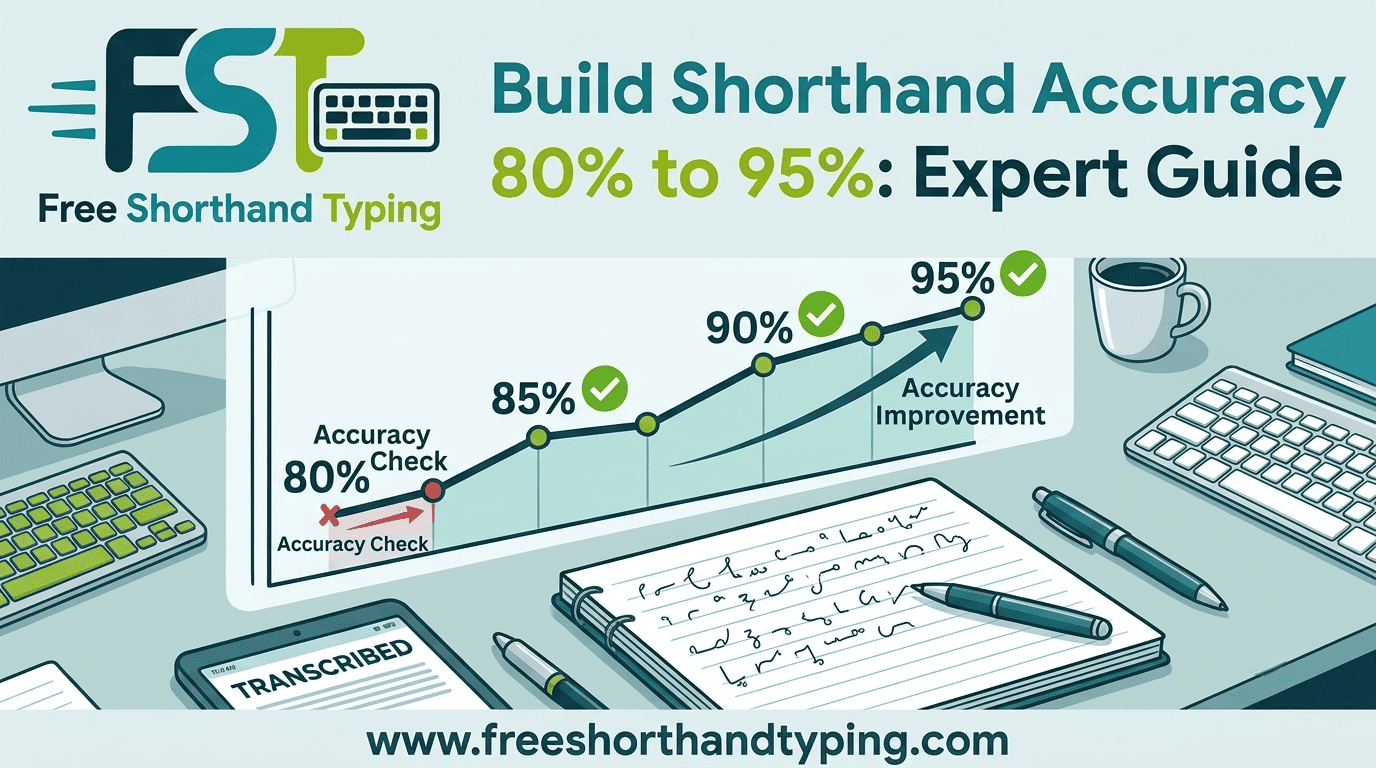
Practical Example: Every Sunday, select an unseen passage from our platform (like a previous year's SSC Stenographer transcript). Treat it as the real exam. No pausing, no rewinding. Transcribe it, calculate your exact error percentage, and log it in a spreadsheet. Seeing the graph move from 80% to 83%, and eventually to 95%, will keep you highly motivated.
7. Common Practice Habits That Prevent Improvement
If you are stuck, you are likely guilty of one of these bad habits:
- Practicing at speeds too high for you: Trying to write at 100 WPM when your 80 WPM is messy destroys your outlines. Slow down to build form, then speed up.
- Ignoring typing fundamentals: Being a great stenographer means nothing if you have a 20 WPM typing speed. You need enough time to read your notes and type comfortably. Regular online typing practice is mandatory.
- Erasing or overwriting: Never trace over a bad outline in your notebook. If you make a mistake, strike a single line through it and write the correct outline next to it.
- Neglecting Hindi font rules: For Hindi stenographers, mixing up Alt codes in Kruti Dev Typing or struggling with the Inscript layout in Mangal Typing will artificially lower your accuracy score.
8. Frequently Asked Questions (FAQs)
Q1: How are mistakes calculated in the SSC Stenographer skill test?
A: Mistakes are categorized as full mistakes (omission of words, substitution of words, addition of words) and half mistakes (spelling errors, singular/plural mistakes, capitalization errors).
Q2: Can I use an eraser during the shorthand dictation?
A: No. Using an eraser wastes valuable seconds. If you make a mistake, strike it out quickly and keep moving.
Q3: How important is typing speed for transcription?
A: Extremely important. A faster typing speed gives you more time to decipher difficult outlines and proofread your final transcript before the timer runs out.
Q4: Should I transcribe every dictation I take?
A: While it is ideal, it can be exhausting. Aim to fully transcribe and review at least one unseen dictation passage every single day.
Q5: What is the best way to handle unknown words during a dictation?
A: Write the consonants you hear. If you hear "Chiaroscuro," write Ch-R-S-K-R. During transcription, the context and the consonant skeleton will usually help you figure it out.
Q6: How do I master Allahabad High Court Formatting?
A: Study the specific notification guidelines. Practice using the Tab key for indents rather than the spacebar, and pay strict attention to legal terminology and punctuation spacing.
Q7: Is Mangal font mandatory for Hindi Stenographers?
A: Most modern government exams (including SSC) offer Mangal (Inscript/Remington) alongside Kruti Dev. Check your specific exam notification and practice consistently on one layout.
Q8: I get nervous during the exam and my accuracy drops. What should I do?
A: This is why we aim for 95%+ in practice. Simulating exam conditions at home—using a countdown timer, taking unseen passages, and wearing headphones—will significantly reduce exam-day anxiety.
Final Conclusion
Building your shorthand dictation accuracy from 80% to 95% is not about finding a magic trick; it is about deliberate, analytical practice. By separating your outline errors from your transcription errors, rigorously reviewing your shorthand notebook, and maintaining a high typing speed, you will naturally bridge the accuracy gap. Stop relying on memory, start respecting the vowels, and treat every daily practice session like the real exam.
Ready to test your accuracy?
Put these strategies to the test using our free dictation audio files and typing interfaces.
Popular Tags:
- Shorthand Dictation
- SSC Stenographer
- Pitman Shorthand
- Typing Accuracy
- Typing Test
- English Typing Test
- Hindi Typing Test
- Government Exam Preparation
- Court Stenographer
- Online Typing Practice
- Free Shorthand Typing
- Typing Speed
- Kruti Dev Typing
- Mangal Typing
- Allahabad High Court Formatting
- Pitman Exercise
- Stenography Skills
- Dictation Practice
- Transcription Accuracy
- Shorthand Mistakes
- Steno Exam Tips
- Shorthand Outlines
- Daily Steno Routine
- Stenography Tips.