Introduction
You have spent months, perhaps years, mastering Pitman Shorthand. You can comfortably take down a high-speed Shorthand Dictation at 80 or 100 words per minute. Yet, when the time comes to sit in front of the computer and transcribe those strokes into English or Hindi, your accuracy suddenly drops. If this scenario sounds familiar, you are certainly not alone. Thousands of candidates fail government skill tests every year, not because their shorthand speed is inadequate, but because their transcription process is deeply flawed.
For exams like the SSC Stenographer or state high court tests, writing fast is only half the battle. The real test happens when you decode your outlines and type them out within a strict time limit. In this comprehensive guide, we will break down the fatal mistakes candidates make during transcription and how you can fix them using the right Online Typing Practice strategies.
Why It Matters
Government exam boards evaluate transcription with brutal precision. In the SSC Stenographer Skill Test, for example, General (UR) candidates are only allowed up to 5% mistakes for Grade C and 7% for Grade D. A few misread words, some spelling errors, or missing punctuation marks can quickly push you over this strict threshold.
Every error is mathematically penalized as either a "Full Mistake" or a "Half Mistake." If your strategy is simply typing whatever you see without context, you are essentially gambling with your career. Perfecting your transcription process ensures that the hard work you put into learning shorthand translates directly into high marks on exam day, securing your position in the government sector.
Benefits of a Structured Transcription Process
By overhauling how you transcribe your notes, you gain several immediate advantages:
- Higher Typing Accuracy: Catching context errors before you type prevents you from inputting the wrong word.
- Reduced Panic: Knowing exactly how to handle unreadable outlines keeps your heart rate down and your fingers moving.
- Better Time Management: You will finish transcribing faster, leaving you with crucial minutes at the end for proofreading.
- Exam Readiness: You will confidently tackle any English Typing Test or Hindi Typing Test, knowing your routine is rock solid.
The 5 Fatal Transcription Mistakes (And How to Fix Them)
1. Typing Immediately Without Reading First
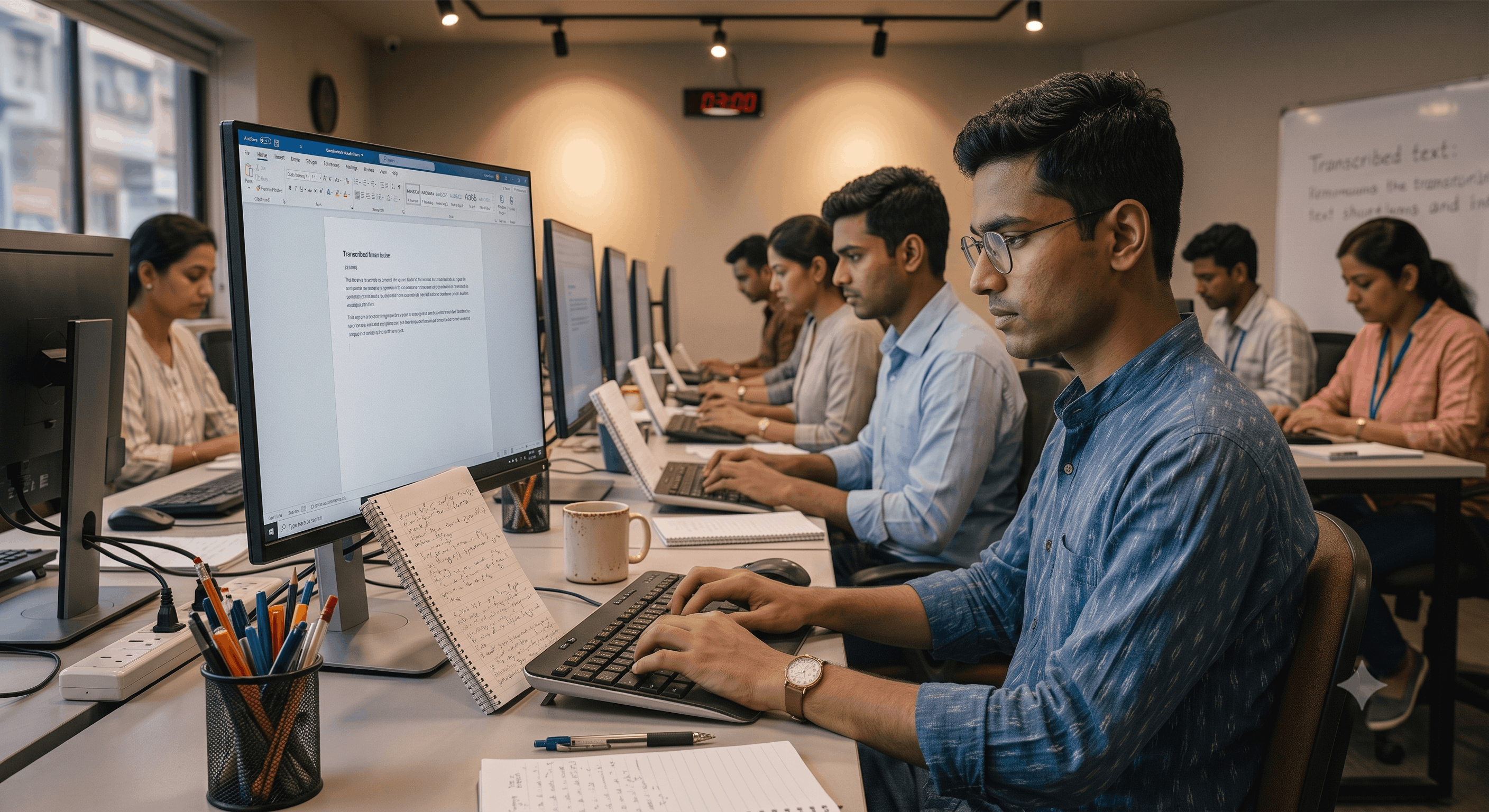
The most common instinct during a skill test is to start typing the second the audio dictation ends. This is a massive mistake. When you type word-by-word without understanding the context of the sentence, a poorly written outline can completely derail your thought process.
The Fix: Always use the first 3 to 5 minutes of your transcription time to quickly skim through your notepad. Lightly insert necessary vowels with a pencil where outlines look ambiguous. Understanding the context of a paragraph helps you instantly recognize difficult strokes when you actually begin typing.
2. Pausing Too Long on a "Dead" Outline
You will inevitably encounter an outline you simply cannot read. Spending 45 seconds staring at a single stroke breaks your typing rhythm, causes anxiety, and eats into your strict time limit.
The Fix: Type a placeholder like a blank space or a recognizable symbol (such as ***) and keep moving forward. Once you finish the entire passage, the context of the surrounding sentences will often make the missing word obvious. During your regular practice at Free Shorthand Typing, you can review the master text to see how that word should have been written.
3. Relying on Manual Proofreading
When practicing at home, most students check their own typed passages against the original PDF by eye. The human brain naturally autocorrects small mistakes, meaning you will subconsciously skip over missing articles like "a," "an," "the," or plural "s" endings. These half-mistakes accumulate silently.
The Fix: Stop relying on your own eyes to catch errors. You must practice using a platform that offers automated evaluation. A computer checking your text will brutally expose the exact grammatical and spelling errors you are making, giving you a true accuracy percentage that reflects real exam conditions.
4. Ignoring Formatting and Punctuation
For specialized exams, formatting is just as critical as raw speed. Candidates often lose precious marks by using the spacebar instead of the Tab key for indentations, or failing to format paragraphs correctly.
The Fix: Treat punctuation marks in your shorthand notes as strictly as the words themselves. Always use a distinct, oversized cross mark for full stops so they aren't confused with words like "the" or "he." If you are preparing for specific court exams, utilize Allahabad High Court Formatting practice tools to build muscle memory for the exact layout required.
5. Letting Typing Speed Mask Shorthand Weaknesses
A candidate with a 60 WPM computer typing speed might think they can afford to transcribe slowly. However, if your shorthand notes are messy, you will spend so much time deciphering them that even blazing-fast fingers won't save you from the ticking clock.
The Fix: Your transcription speed is ultimately dictated by your reading speed, not your typing speed. If you are struggling to finish within the time limit, the root cause is usually poor shorthand phrasing or missing vowels, not slow fingers. Dedicate time to a foundational Pitman Exercise to clean up your basic strokes.
Step-by-Step Guide to Flawless Transcription
Follow this exact sequence during your next mock test to see an immediate improvement in your scores:
- Take the Dictation: Focus purely on capturing the sounds. Do not worry about grammar or spelling yet.
- The Quick Skim: Spend 3 minutes reading the shorthand notes. Add vowels to confusing words.
- Continuous Typing: Type smoothly without stopping. If you hit a roadblock, leave a space and move on.
- Contextual Fill-in: Go back to your blank spaces. Use the surrounding sentence to guess the missing word logically.
- The Final Proofread: Spend the last 5 minutes checking for spelling, singular/plural agreement, and capitalization.
Practical Examples: Understanding Error Evaluation
To pass, you must understand how your transcription is actually graded. Here is a breakdown of how the Staff Selection Commission typically evaluates errors:
| Type of Mistake | Example | Penalty |
|---|---|---|
| Omission | Skipping a dictated word entirely. | Full Mistake |
| Substitution | Typing "nation" instead of "country". | Full Mistake |
| Addition | Adding an extra word like "the" that was not dictated. | Full Mistake |
| Spelling Error | Typing "recieve" instead of "receive". | Half Mistake |
| Singular/Plural | Typing "student" instead of "students". | Half Mistake |
| Capitalization | Writing "central government" in lowercase. | Half Mistake |
Pro Tip for Hindi Typists: If you are practicing for a Hindi transcription exam, ensure you are practicing on the correct font layout. Depending on your specific exam notification, you must master either Kruti Dev Typing or Mangal Typing (Inscript/Remington Gail). Mixing up your alt-codes on exam day is a recipe for disaster.
Frequently Asked Questions (FAQ)
1. How many mistakes are allowed in the SSC Stenographer Skill Test?
For Grade C, General category candidates are allowed up to 5% mistakes. For Grade D, the limit is 7%. Reserved categories have slightly relaxed limits (up to 7% for Grade C and 10% for Grade D).
2. Does spelling matter if the phonetic sound is correct?
Yes. Shorthand captures phonetics, but your computer transcription must use standard dictionary spelling. Spelling errors are counted as half mistakes.
3. Should I memorize capitalization rules?
Absolutely. Failing to capitalize proper nouns, government acts, and designations (like Prime Minister or Supreme Court) will result in half mistakes that add up very quickly.
4. Is backspace allowed during the typing test?
In almost all modern computer-based skill tests, including SSC, full use of the backspace and arrow keys is allowed during your allotted transcription time.
5. How can I improve my typing speed for transcription?
Take dedicated typing tests separate from your shorthand practice. Building your baseline Typing Speed to at least 40 WPM in English or 35 WPM in Hindi ensures you have plenty of time to read your notes.
6. What if I missed a whole sentence during dictation?
Do not panic. Leave a paragraph break and continue with the next sentence you captured. A missed sentence is a series of full mistakes, but losing your composure will cause you to fail the entire passage.
7. Can I use a pencil or a pen for shorthand?
A high-quality shorthand pencil is highly recommended. Pencils allow you to write light and heavy strokes distinctly, which is a core component of Pitman shorthand.
8. How do I practice Allahabad High Court specific formats?
The AHC requires specific margins, indentations, and capitalization rules. You must practice using a simulator that replicates this exact environment to build the correct muscle memory.
Conclusion
Achieving success in Government Exam Preparation requires more than just fast hands; it requires a strategic mind. Transcription is the bridge between hearing the spoken word and delivering a flawless document. By reading your notes before typing, avoiding the trap of manual proofreading, and understanding exactly how mistakes are counted, you can confidently walk into your skill test and secure your future.
Take Your Practice to the Next Level
Stop guessing your accuracy and start practicing like a professional. Join Free Shorthand Typing today to access a massive library of dictations, automated error evaluation, and specialized formatting tools. Whether you need an English Typing Test, rigorous Hindi practice, or complete SSC mock exams, we have the tools you need to succeed.
Start your free online typing practice now and conquer your upcoming skill test!